

In today’s international market, the phrase “sustainable building” isn’t a passing buzzword—it is a strict legal and commercial barrier to entry. If you are exporting vinyl flooring into high-stakes markets like the USA or Canada, there is one technical seal you absolutely cannot afford to miss on your retail packaging: FloorScore®.
Let’s strip away the heavy corporate jargon and look at exactly what FloorScore® is, who tests it, and why this certification is your ultimate passport to premium commercial bids.
What Exactly Is the FloorScore® Certification?
In simple terms, FloorScore® is the most recognized global indoor air quality (IAQ) certification standard specifically designed for hard-surface flooring materials, underlayments, and adhesives.
Because floors like SPC and LVT are engineered using polyvinyl chloride and stabilizing compounds, international environmental agencies want to know exactly what happens when those planks are installed inside an enclosed, unventilated room. FloorScore® guarantees that the flooring product complies with strict indoor air chemical emission thresholds.
Who Issues FloorScore®?
The certification program was co-developed by the Resilient Floor Covering Institute (RFCI) alongside SCS Global Services (Scientific Certification Systems), a highly respected third-party environmental auditing giant based in the USA. SCS Global Services acts as the independent “referee,” running rigorous lab tests before any manufacturer can display the certified green logo.
What Does FloorScore® Actually Test For?
FloorScore® doesn’t just look at a product sample and sign a paper. It utilizes an intensive scientific process known as “chamber testing.”
A factory sample of the vinyl flooring is placed inside a clean, climate-controlled steel chamber for several days. Specialized sensors then capture and analyze the air to measure the precise levels of volatile organic compounds (VOCs) leaking out of the floor.
- The 35 VOC Screen: The laboratory actively measures the emission rates of 35 individual hazardous chemicals.
- The Formaldehyde Target: The test tracks formaldehyde with extreme scrutiny. Formaldehyde is a toxic chemical common in low-grade adhesives and recycled plastics that can cause respiratory irritation and long-term health risks.
- The Passing Grade: To receive a certificate, the flooring line must emit levels well below the hyper-strict safety thresholds mandated by the California Department of Public Health (CDPH Standard Method v1.2).
Why Sourcing FloorScore® Certified Lines Is Crucial for Your Business
As a B2B sourcing manager, paying attention to this certificate isn’t just about environmental ethics—it is a highly strategic commercial defense mechanism.
1. Smooth Customs Clearance (Zero Port Headaches)
Customs enforcement agencies, particularly in North America, are increasingly strict about indoor chemical safety regulations. Importing non-certified plastic composites can result in your containers being held for mandatory testing, saddling your business with massive demurrage fees or a completely rejected shipment.
2. The Golden Key to Commercial Bids (LEED Eligibility)
If your sales team wants to pitch to commercial architects, high-end real estate developers, or public school projects, FloorScore® is practically a mandatory prerequisite. It automatically qualifies your flooring products for major green building frameworks, such as LEED (Leadership in Energy and Environmental Design) v4, CHPS, and the Green Guide for Health Care.
3. Protects and Elevates Your Brand Equity
Nothing kills a private-label brand faster than an end-user complaining about a harsh, toxic “plastic chemical smell” inside their freshly renovated home or retail space. FloorScore® ensures your inventory arrives entirely odorless and non-toxic, protecting your brand from negative reviews and costly after-sales liability claims.
The Hidden Sourcing Trap: 100% Virgin Resin vs. Recycled Plastics
Here is a manufacturing secret that separates low-grade factories from elite OEM operations: It is incredibly difficult to pass a FloorScore® audit using recycled plastic cores.
- The Risk of Recycled Plastic: Cheap flooring lines often utilize post-consumer plastic waste to cut manufacturing costs. Because this waste comes from unstable, mixed plastic streams, it frequently contains legacy heavy metals (like lead or cadmium) and volatile chemical stabilizers that outgas constantly, resulting in a failed FloorScore® test.
- The Security of Virgin Resin: To secure an unquestionable, clean passing grade year after year, top-tier factories utilize 100% virgin polymer matrices. Virgin resin is completely pure, medical-grade raw material, ensuring predictable, non-toxic behavior under rigorous laboratory testing.
In conclusion
Ensuring your flooring collections hold a valid FloorScore® certification is the ultimate way to safeguard your international supply chain, pass customs smoothly, and win high-margin commercial contracts. As an export-focused manufacturing leader out of Vietnam since 2010, VN Ecofloor is the trusted OEM partner built to support your compliance needs. We engineer premium SPC and LVT lines utilizing strictly 100% virgin resin cores, guaranteeing your inventory is completely odorless, non-toxic, and fully certified in our own name to pass the world’s strictest indoor air quality audits. Let us handle the technical testing and manufacturing compliance so you can focus on scaling your brand’s market share with absolute peace of mind.
Hotline/WhatsApp: +84 88 801 81 28
Official Website: vnecofloor.com
FAQs
- What is FloorScore® certification in flooring?
FloorScore® is an indoor air quality certification for hard-surface flooring materials, including SPC, LVT, underlayments, and adhesives. It shows that the flooring product has been tested for chemical emissions and meets strict indoor air quality requirements, making it safer for enclosed spaces such as homes, offices, schools, and commercial buildings.
- Why is FloorScore® important for SPC and LVT flooring buyers?
For SPC and LVT flooring buyers, FloorScore® is important because it helps prove that the product has low VOC emissions. This gives wholesalers, importers, and private-label brands more confidence when selling into markets where indoor air quality, green building standards, and customer safety are major concerns.
- Who issues the FloorScore® certification?
FloorScore® was developed by the Resilient Floor Covering Institute (RFCI) together with SCS Global Services. SCS Global Services acts as the independent certification body, testing and verifying whether a flooring product meets the required indoor air quality emission standards before the FloorScore® label can be used.
- What does FloorScore® test for?
FloorScore® mainly tests for VOC emissions released from flooring products into indoor air. The testing process uses controlled chamber testing to measure specific chemicals, including formaldehyde and other volatile organic compounds. If the emission levels stay within the required limits, the product can qualify for FloorScore® certification.
- Does FloorScore® certification help with commercial projects?
Yes. FloorScore® certification can be a strong advantage when selling flooring to commercial projects, architects, developers, schools, healthcare spaces, and green building projects. Many buyers prefer or require certified low-emission flooring because it helps support healthier indoor environments and may contribute to green building programs.
- How can buyers verify if a FloorScore® certificate is real?
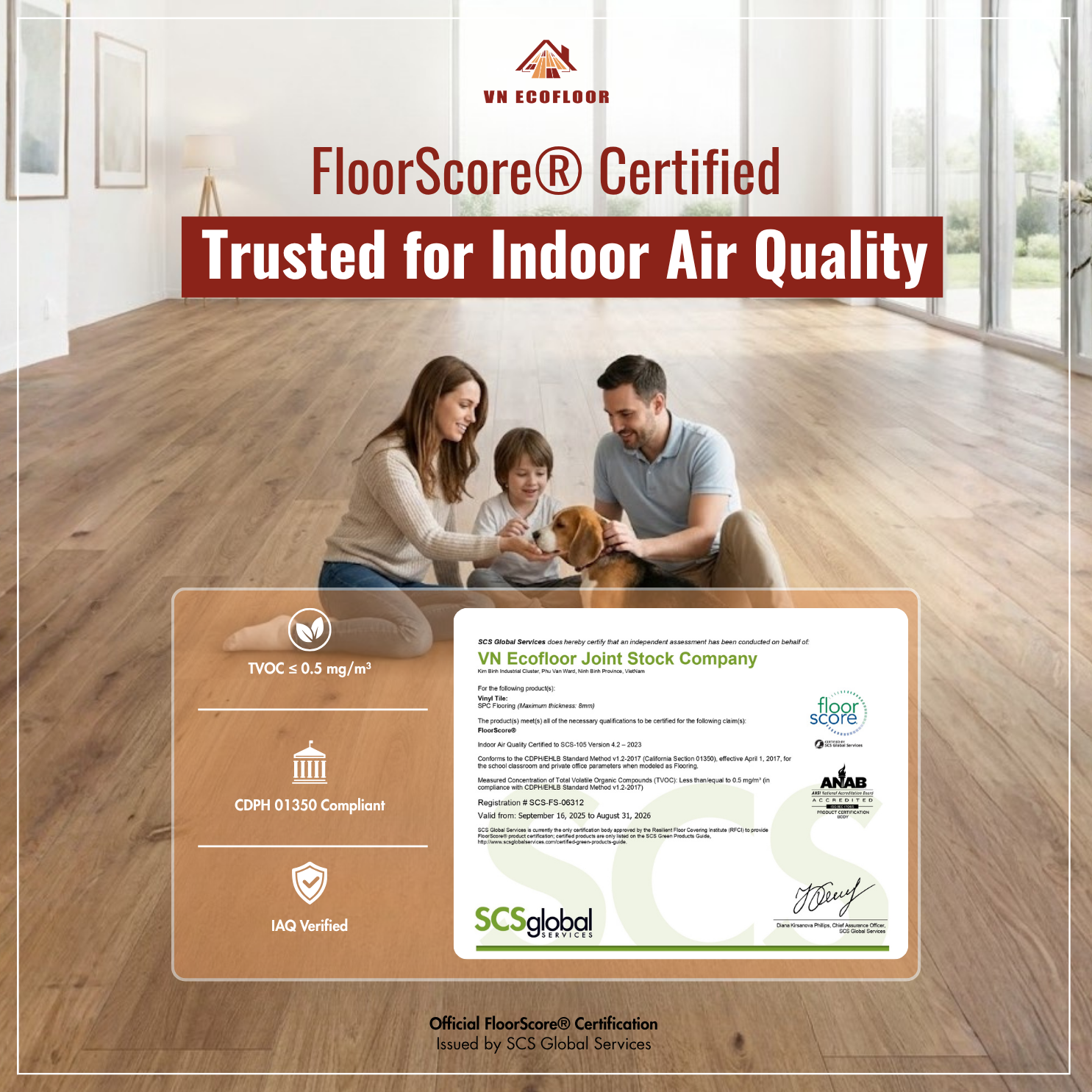
Buyers should ask the supplier for the full certificate, product name, certificate number, issuing body, testing scope, and validity period. A reliable manufacturer should be able to provide traceable documentation instead of only showing the FloorScore® logo on a catalog or product box. When needed, buyers can also verify the certificate through the issuing organization.