


In the international market, flooring certifications are the ultimate keys to global trade. If you are looking to tap into the massive, high-margin consumer base across the European Union (EU), there is one non-negotiable mark: the CE Mark.
Let’s strip away the bureaucratic legal talk and look at exactly what the CE certification is, what it tests for, and why it is your mandatory passport to doing business in Europe.
What Exactly Is the CE Certification?
The letters “CE” stand for Conformité Européenne, which translates from French to European Conformity. It is crucial to understand that the CE mark is not a voluntary quality badge or a commercial marketing gimmick. It is a mandatory regulatory conformity marking required for specific products sold within the European Economic Area (EEA).
Think of it as a legal passport for your goods. When an OEM factory affixes the CE mark to its flooring products or packaging, it is declaring to EU customs and market surveillance authorities that the flooring complies with all essential European safety, health, and environmental protection legislation. Without a valid CE mark, your shipping containers cannot legally cross the border into the EU, exposing your business to devastating port fines, shipping delays, or seized inventory.
What Does the CE Mark Test For?
For resilient flooring products like Stone Plastic Composite (SPC) and Luxury Vinyl Tile (LVT), compliance is governed by the rigorous European harmonized standard, EN 14041.
European laboratories do not just look at a product and sign off on it; they subject the planks to strict mechanical and chemical evaluations. To pass the EN 14041 audit, an OEM floor must hit concrete benchmarks across four critical safety zones:
1. Reaction to Fire (EN 13501-1)
Europe takes building fire safety incredibly seriously. The flooring is exposed to controlled flames to measure how fast it ignites, how quickly the flame spreads, and how much smoke it produces. For premium commercial-grade SPC flooring, factories typically aim to pass the stringent Class Bfl-s1 rating, proving the material is highly flame-retardant and safe for public spaces.
2. Formaldehyde Emissions (Class E1)
Indoor air quality is a massive health priority in Europe. The laboratory measures the rate of toxic chemical outgassing from the floor. To pass the baseline CE requirement, the product must meet the Class E1 standard, ensuring the flooring does not leak harmful amounts of formaldehyde into enclosed living environments.
3. Slip Resistance (EN 13893)
To protect consumers from accidental slips and falls, the flooring surface undergoes dynamic friction testing. Passing this ensures the floor provides safe traction underfoot, a vital selling point for high-traffic retail spaces, kitchens, and commercial developments.
4. Electrical and Antistatic Behavior
The flooring is tested to measure its electrical propensity. It must ensure that walking across the room doesn’t build up dangerous levels of static electricity, which could interfere with sensitive electronics in modern offices or smart homes.
Watch Out for “Borrowed” Certificates
Here is a critical piece of insider manufacturing knowledge for B2B buyers: Always verify the authenticity of the test reports.
Many low-grade trading companies or young factories will show you beautiful CE documents during initial negotiations. However, if you look closely at the fine print, the certificate often belongs to a completely different sub-supplier, a raw-material vendor, or an unrelated corporate entity.
If you print a borrowed or illegitimate CE mark on your private-label retail boxes and an EU customs audit catches the discrepancy, your entire shipment can be blacklisted. You must ensure your OEM factory partner holds these certificates in their own name, backed by an audited, traceable manufacturing facility.
Why CE Matters to Wholesalers
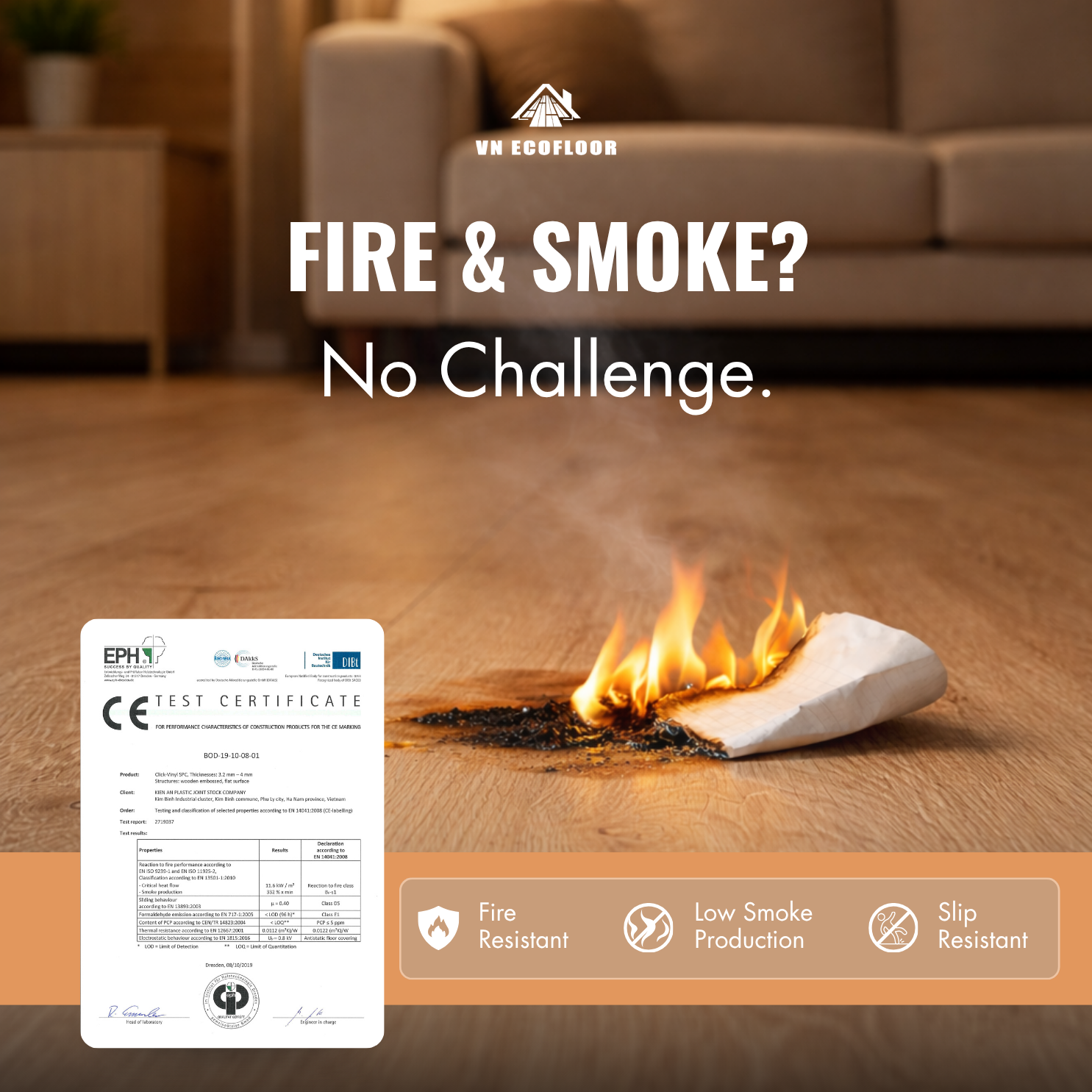
As a B2B sourcing professional, insisting on a factory-backed CE certification provides three massive advantages for your brand:
- Unrestricted European Distribution: A single CE mark grants your private label legal access to all 27 EU member states, plus Iceland, Liechtenstein, and Norway. You can seamlessly shift inventory across borders without needing separate national safety approvals
- A Shield Against Liability: Selling certified products protects your wholesale business from catastrophic legal liabilities or product recalls down the line, ensuring your brand equity remains completely secure.
- Architect and Contractor Trust: Commercial builders and designers will instantly throw out a bidding proposal if the materials lack verified CE tracking. Holding this mark opens the door to high-value commercial and government tenders.
In conclusion
Ensuring your flooring collections carry a valid, traceable CE certification is the ultimate way to protect your international supply chain and unlock high-margin European contracts. As an export-focused manufacturing leader out of Vietnam since 2017, VN Ecofloor is the trusted OEM partner built to support your international compliance needs. We engineer premium SPC and LVT lines utilizing strictly 100% virgin resin cores and precision click-lock milling, ensuring your inventory is entirely safe, non-toxic, and fully certified in our own name to pass the world’s strictest customs audits. Let us handle the technical testing and international regulatory compliance so you can focus on scaling your private label with absolute peace of mind.
Hotline/WhatsApp: +84 88 801 81 28
Official Website: vnecofloor.com
FAQs
- What is CE certification in flooring?
CE certification, or CE marking, shows that a flooring product meets the required European safety, health, and environmental protection standards. For SPC and LVT flooring, the CE mark helps prove that the product is suitable for legal sale within the European Economic Area.
- Is CE marking mandatory for flooring sold in Europe?
Yes. For many flooring products sold in the European market, CE marking is a mandatory regulatory requirement, not just a marketing label. Without valid CE documentation, importers may face customs issues, shipment delays, rejected goods, or problems selling the product legally in the EU.
- What does CE certification test for in SPC and LVT flooring?
For resilient flooring such as SPC and LVT, CE compliance is commonly linked to the EN 14041 standard. Testing may cover reaction to fire, slip resistance, formaldehyde emissions, and electrical or antistatic behavior. These results help confirm that the flooring meets key safety and performance requirements for the European market.
- Why does CE certification matter for wholesalers and importers?
CE certification helps wholesalers and importers reduce legal and commercial risk. It supports smoother European distribution, builds trust with retailers and contractors, and helps buyers avoid problems such as non-compliant packaging, customs delays, product recalls, or failed project bids.
- How can buyers check whether a CE certificate is valid?
Buyers should ask for the full CE documentation, test reports, product name, tested specification, issuing laboratory, standard used, and company name on the certificate. The certificate should match the actual manufacturer and product being ordered. If the document belongs to another factory or unrelated supplier, it may not properly protect your shipment.