

In the international market, flooring certifications are the ultimate keys to global trade. They aren’t just decorative badges to slap on your retail packaging; they are verifiable proof that your product is safe to breathe, structurally stable, and legally compliant in high-stakes markets like the USA, Canada, Europe, and Australia.
Navigating the alphabet soup of international testing bodies can be incredibly confusing. Let’s strip away the bureaucratic jargon and look at exactly what these essential certifications are, who issues them, and what they actually test for.
1. Clean Air Certifications
Indoor Air Quality (IAQ) is the single most scrutinized factor by international customs and green building councils today. Because vinyl flooring (SPC and LVT) utilizes chemical polymers, buyers must verify that the product doesn’t emit harmful gases into enclosed spaces.
1.1 FloorScore®
This is the premier global indoor air quality certification standard for hard surface flooring materials. It was developed by the Resilient Floor Covering Institute (RFCI) and is independently tested and certified by SCS Global Services (USA). This is the most “powerful” certificate in the industry and is practically mandatory if you want to export flooring into the USA and Canada. Floors with the FloorScore® logo are the only ones eligible to win major green building contracts under the LEED framework.
They run rigorous, long-term chamber testing to measure the emission levels of 35 individual Volatile Organic Compounds (VOCs), with a hyperfocus on Formaldehyde (a known carcinogen found in low-grade plastics and glues). Passing means the floor is entirely safe and odorless in a sealed room.
1.2 TÜV Rheinland
This is a premium certification verifying technical safety, chemical purity, and product quality according to strict European benchmarks. Issued by TÜV Rheinland, an independent German testing giant with over 150 years of history. The TÜV mark carries massive, unquestioned prestige across Europe and highly developed Asian markets.
They run comprehensive chemical and mechanical safety audits. They test for heavy metals, toxic phthalate plasticizers, flame-spread ratings, and the floor’s response to artificial weathering and friction.
2. Crossing the Border Legally
Without these baseline regulatory marks, your shipping containers run a high risk of being held at the port, resulting in devastating demurrage fees and canceled retail contracts.
2.1 CE Marking (Conformité Européenne)
This is a mandatory conformity marking required for products sold within the European Economic Area (EEA). It is not a voluntary quality badge—it is a legal obligation. The manufacturer self-declares compliance, but it must be backed by a certified test report from an EU-authorized laboratory (Notified Body). Without a valid CE mark printed on your packaging, your container cannot legally pass European customs.
They test the core consumer safety requirements under European standard EN 14041, including: Fire performance (typically aiming for Class Bfl-S1), slip resistance, Formaldehyde release limits (Class E1), and electrical/static safety.
3. Other Independent Testing Bodies
The organizations listed below do not issue a single certificate bearing their name; instead, they operate as elite, independent third-party laboratories. Their Test Reports carry absolute legal weight and are trusted universally by global buyers.
3.1 SGS
Headquartered in Switzerland, SGS (Société Générale de Surveillance) is the world’s largest and most trusted inspection, verification, and testing company. An SGS test report is accepted unconditionally by every customs agency and big-box retailer on earth.
Wholesalers rely on SGS to verify the hard, physical truth of a factory’s spec sheet. They test the exact purity of the resin core (via density analysis), the precise thickness of the wear layer, peel strength, resistance to domestic chemicals, and heavy metal concentrations.
3.2 SATRA Technology
Based in the UK, SATRA is Europe’s leading independent research and testing organization for construction and consumer goods. If you are a wholesaler bidding on high-end commercial projects in the UK or the EU, architects will almost always demand a SATRA test report.
SATRA specializes in “heavy-duty mechanical torture tests.” They test click-locking joint tensile strength, dimensional stability (how much the core expands or shrinks under extreme heat), and the famous Castor Chair Test (rolling a heavy office chair back and forth over the floor thousands of times to see if the surface delaminates).
3.3 Intertek Testing Services
A massive British multinational testing giant and the primary competitor to SGS, holding massive authority across North American distribution networks.
Intertek is world-renowned for its fire-safety and flame-spread testing (such as the critical ASTM E648 radiant panel test in the US). They measure exactly how fast a flame spreads across the SPC/LVT plank and how much smoke density it generates during a fire code emergency.
4. Factory Management Audits
Product tests are fantastic, but as a B2B buyer ordering multiple containers a year, you need to know that the factory itself runs a disciplined, uniform operation.
ISO 9001 & ISO 14001

ISO 9001 is the global standard for Quality Management Systems; ISO 14001 tracks Environmental Management. They are issued by accredited international auditing bodies that physically inspect the factory floor annually.
They don’t test individual planks; they test the factory’s process stability. They audit the quality control (QC) workflow to ensure that the chemical compounding recipe remains identical between batch number 1 and batch number 100, while ensuring the plant handles waste responsibly.
Why Global Brands Centralize Compliant Production with VN Ecofloor
Navigating international compliance can be a major headache, and you cannot afford to risk your brand’s reputation on borrowed factory paperwork or unverified test sheets. You need an established, fully certified OEM vinyl flooring partner who views quality control as an exact science.
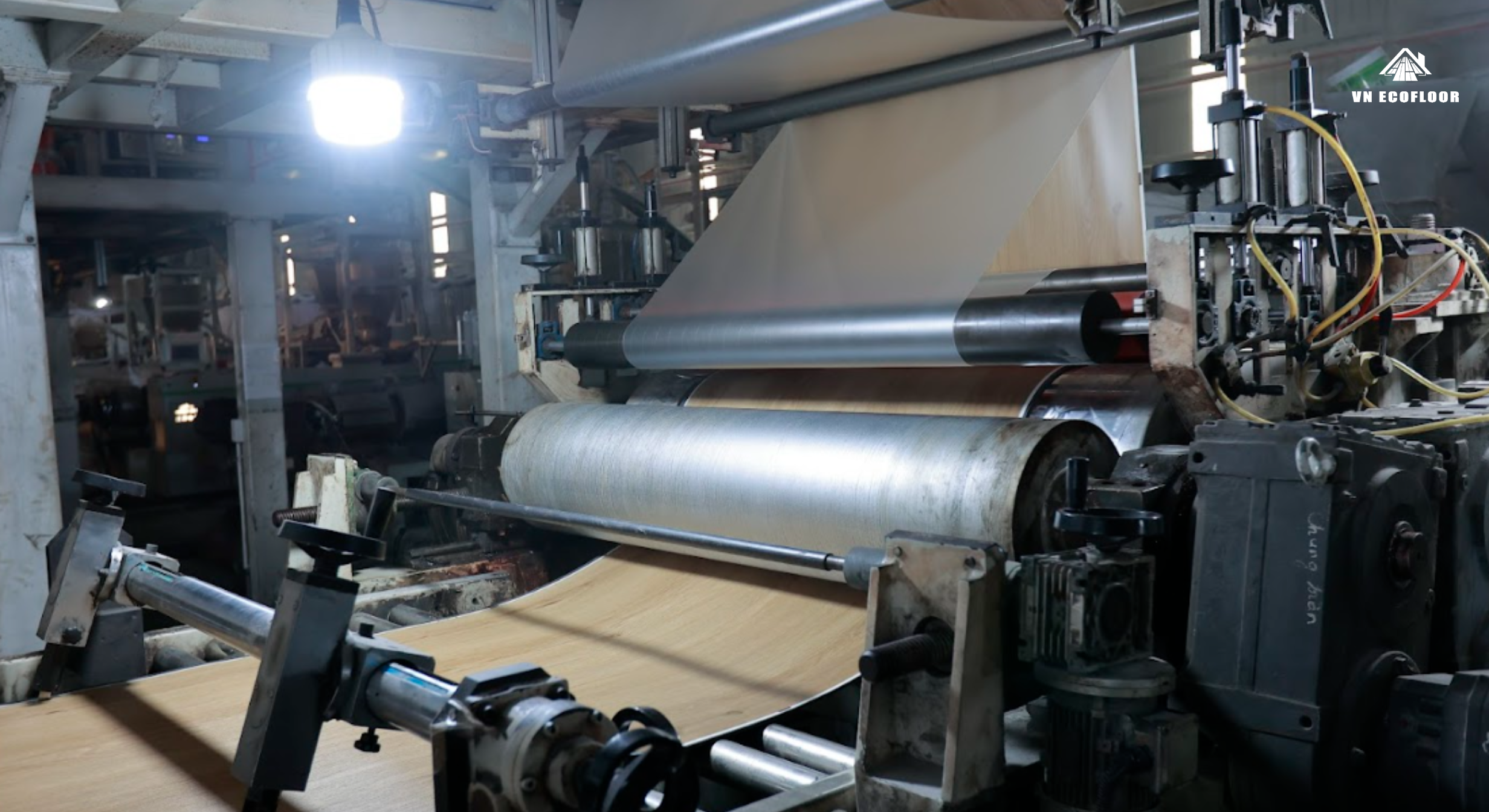
That is exactly why leading international wholesalers build their collections with VN Ecofloor.
Operating as an export-focused manufacturing leader out of Vietnam since 2017, the VN Ecofloor team brings nearly 10 years of global export wisdom directly to your supply chain, smoothly servicing the highly demanding markets of the USA, Canada, and Europe.
- Fully Certified & Traceable Portfolio: We don’t hide behind sub-supplier paperwork. VN Ecofloor actively holds valid, verifiable certifications across the board, including FloorScore®, CE, ISO 9001, and ISO 14001. Our products regularly undergo rigorous independent testing via SGS, Intertek, and TÜV to ensure absolute compliance.
- Strictly 100% Virgin Resins: The secret to effortlessly passing strict chemical emission tests is our raw material purity. We engineer our SPC and LVT cores using strictly 100% Virgin Resin. This guarantees our floors are completely odorless, non-toxic, and free of legacy heavy metals.
- End-to-End OEM Customization: We streamline your entire sourcing pipeline under one roof. From precision wear layer extrusion and custom EIR texturing to advanced surface finishes (Ceramic Bead /Aluminium Oxide UV) and private-label box printing, we deliver your containers 100% retail-ready and customs-compliant.
Don’t let compliance headaches block your market expansion. Partner with a veteran manufacturer built to pass the world’s strictest audits.
👉 [VISIT VN ECOFLOOR] Ready to inspect our verified laboratory test reports, check our compliance documentation, or order a physical technical sample kit? Head over to our official website at vnecofloor.com to explore our full manufacturing setup and receive a quotation today.
FAQs
1. What are flooring certifications?
Flooring certifications are official documents or marks that show a flooring product has been tested for safety, performance, or regulatory compliance. For SPC and LVT flooring, these certifications may cover indoor air quality, fire performance, slip resistance, chemical emissions, dimensional stability, and factory management systems.
2. Why are flooring certifications important for B2B buyers?
For wholesalers, importers, and private-label brands, flooring certifications help reduce sourcing risk. They prove that the flooring product meets certain market requirements and can be sold more confidently in regions such as the USA, Canada, Europe, and Australia. Without proper flooring certifications, buyers may face customs delays, rejected shipments, failed project bids, or customer trust issues.
3. What is FloorScore® certification in flooring?
FloorScore® is an indoor air quality certification for hard surface flooring. It tests whether the floor meets strict limits for VOC emissions, helping buyers confirm that the product is safer for indoor spaces such as homes, apartments, offices, schools, and commercial buildings. For buyers targeting North America, FloorScore® is one of the most recognized certifications in the flooring industry.
4. Is CE marking required for flooring sold in Europe?
Yes, CE marking is required for many construction-related products sold in the European Economic Area, including certain flooring products. For SPC and LVT flooring, CE marking helps show that the product meets relevant European safety and performance requirements, such as fire reaction, slip resistance, and formaldehyde emission limits.
5. What is the difference between a certification and a test report?
A certification is usually an official approval or conformity mark issued under a specific standard or program. A test report, on the other hand, shows detailed laboratory results for a specific product sample. For example, SGS, Intertek, TÜV, or SATRA may provide test reports that verify performance factors such as wear layer thickness, heavy metals, fire behavior, dimensional stability, or click-lock strength.
6. What flooring certifications should wholesalers ask suppliers for?
Wholesalers should ask for flooring certifications and reports based on their target market. Common documents include FloorScore® for indoor air quality, CE marking for Europe, ISO 9001 for quality management, ISO 14001 for environmental management, and third-party test reports from laboratories such as SGS, Intertek, TÜV, or SATRA. Buyers should also confirm that the documents are valid, recent, and linked to the actual product being ordered.
7. How can buyers verify if a flooring certificate is real?
Buyers should ask the supplier for the full certificate, test report number, issuing organization, product name, model/specification, testing date, and validity period. A reliable supplier should be able to provide traceable documents instead of only showing a logo on a brochure or packaging. When needed, buyers can also contact the issuing laboratory or certification body to confirm whether the document is authentic.