


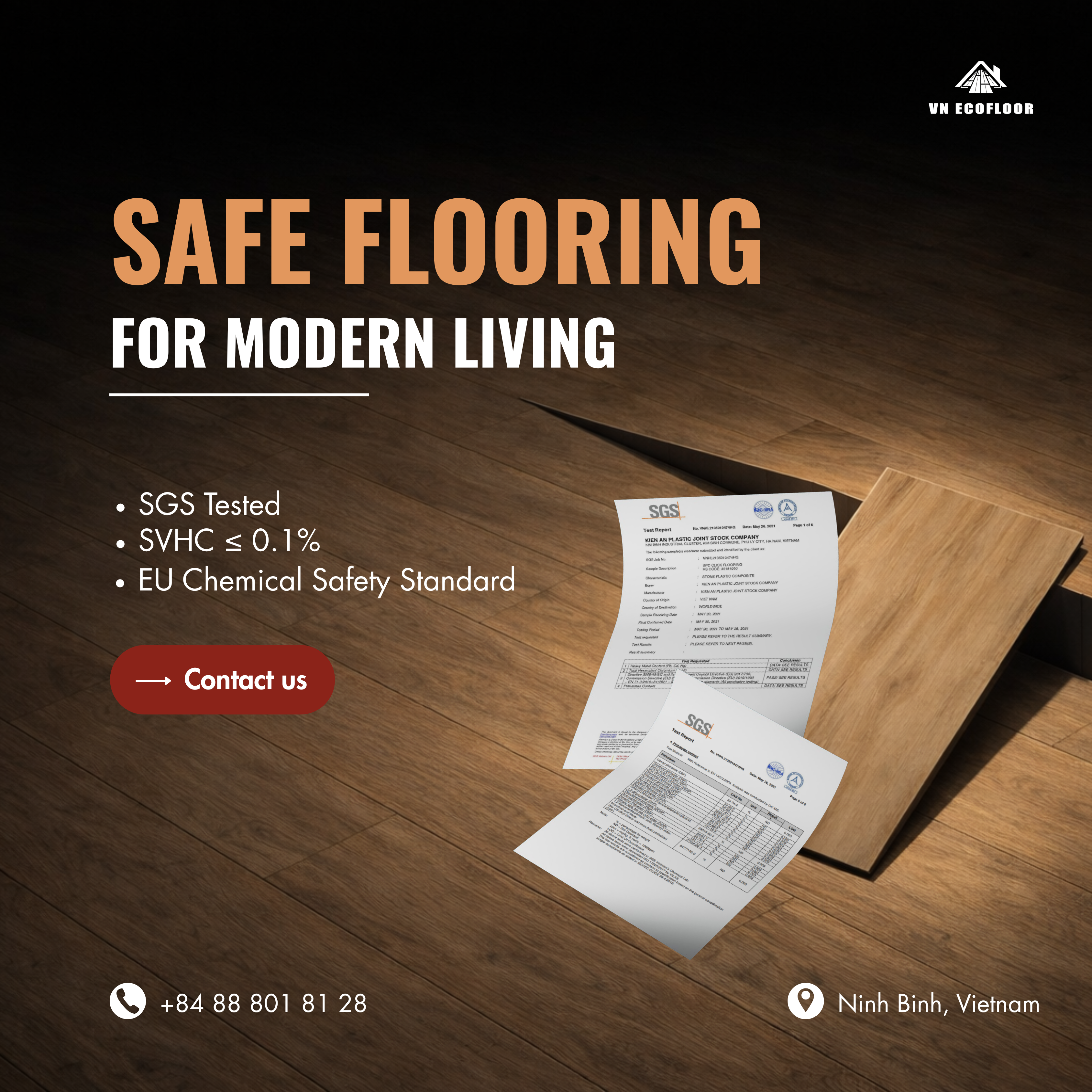
In the international B2B flooring market, you don’t rely on a factory’s promises—you rely on an independent, third-party SGS Test Report.
Let’s strip away the dry corporate talk and look at exactly what an SGS Test Report is, what critical metrics it evaluates in vinyl flooring, and why this report is your ultimate commercial shield against costly product claims.
What Exactly Is an SGS Test Report?

To understand what the report is, you first need to know the organization behind it. SGS (formerly Société Générale de Surveillance) is the world’s leading multinational inspection, verification, testing, and certification company. Headquartered in Switzerland, SGS operates an elite global network of state-of-the-art laboratories.
An SGS Test Report is an official, legally binding document issued after the laboratory subjects a factory’s flooring samples to a battery of rigorous mechanical, physical, and chemical stress tests.
SGS does not own a flooring brand, and they do not sell raw materials. They act entirely as a completely neutral, independent “referee.” Because of their absolute objectivity, an SGS Test Report carries undisputed global weight—it is accepted unconditionally by customs agencies, big-box retailers, and construction lawyers worldwide.
What Does SGS Actually Test For?
When an OEM flooring manufacturer submits SPC or LVT lines to SGS, the material is put through extreme testing parameters to verify its long-term durability and safety. Here are the core metrics that matter to your sourcing portfolio:
1. Core Material Purity & Composition
SGS uses advanced thermal and density analysis to verify the exact chemical makeup of the rigid core. This test checks whether the factory is genuinely using a high-density matrix or hiding cheap, contaminated post-consumer plastic waste inside the core. A clean SGS report guarantees a stable compound.
2. Precise Physical Dimensions & Wear Layer Thickness
Wholesalers pay a premium for specific wear layer protection (such as 0.3mm, 0.5mm, or 0.7mm). SGS technicians utilize high-magnification cross-sectional microscopy to measure the exact thickness of the wear layer down to the micrometer. They also verify dimensional stability—measuring exactly how many fractions of a millimeter the plank expands or shrinks when exposed to high temperatures (80°C).
3. Peeling Strength & Adhesion
For LVT and multi-layer vinyl, delamination is a commercial nightmare. SGS runs advanced mechanical pull tests to measure the Peeling Strength (EN 431 / ASTM F1303). This determines how much force is required to separate the wear layer from the design film and core, ensuring the floor won’t peel apart under heavy foot traffic or rolling heavy loads.
4. Heavy Metal & Toxic Chemical Screenings
To ensure the product complies with international indoor air standards like REACH (Europe) or Proposition 65 (USA), SGS screens the flooring material for harmful substances. They check for heavy metals (like Lead, Cadmium, and Mercury) and toxic Phthalate plasticizers, proving the floor is 100% safe for active families and pets.
Why Sourcing Flooring with Valid SGS Reports Is Vital for Wholesalers
As a B2B sourcing manager, insisting on updated, factory-specific SGS test reports provides three massive commercial advantages for your private-label brand:
- Eliminates Container-Level Callbacks: Discovering a structural issue after importing ten containers across the ocean can bankrupt a distributor. A valid SGS report catches manufacturing flaws before the goods ever leave the port of departure.
- Builds Instant Trust with Big-Box Retailers: When you pitch your flooring lines to large retail buying networks, they will ask for third-party verification. Handing over a verified SGS report instantly fast-tracks your brand approval process.
- A Shield Against Warranty Claims: If a contractor claims your floor warped or failed prematurely, an official SGS data sheet serves as your definitive legal baseline, proving your product meets international architectural engineering standards out of the box.
In conclusion
An SGS Test Report is the ultimate tool for verifying material honesty, ensuring seamless customs clearance, and protecting your wholesale business from catastrophic product liability.
Operating as an export-focused manufacturing leader out of Vietnam since 2017, VN Ecofloor is the trusted OEM partner built to support your brand’s strict quality assurance standards. We engineer our premium SPC and LVT flooring lines utilizing strictly 100% Virgin Resin cores and precision click-lock systems, ensuring every container we ship effortlessly passes rigorous independent screenings via SGS, Intertek, and TÜV Rheinland.
Let us handle the high-precision technical testing and automated quality control so you can focus on expanding your private label across the global market with absolute confidence.
👉 [VISIT VN ECOFLOOR TO REVIEW OUR SGS TEST REPORTS]
Hotline/WhatsApp: +84 88 801 81 28
Official Website: vnecofloor.com
FAQs
- What is an SGS Test Report in flooring?
An SGS Test Report is an independent third-party laboratory report that verifies the quality, safety, and performance of a flooring product. For SPC and LVT flooring, it can help confirm whether the product meets specific technical requirements such as wear layer thickness, dimensional stability, chemical safety, peeling strength, and material composition.
- Why is an SGS Test Report important for flooring buyers?
For wholesalers and importers, an SGS Test Report helps reduce sourcing risk. Instead of relying only on a supplier’s product claims, buyers can use SGS data to check whether an independent laboratory has tested the flooring. This is especially important before placing bulk orders or building a private-label flooring line.
- What does SGS usually test for in SPC and LVT flooring?
SGS can test many flooring performance factors, including core material composition, product thickness, wear layer thickness, dimensional stability, peeling strength, chemical resistance, heavy metals, phthalates, and other restricted substances. The exact test items depend on the buyer’s target market and product requirements.
- Is an SGS Test Report the same as a certification?
Not exactly. An SGS Test Report shows the laboratory test results for a specific product sample. A certification usually means a product or factory has met the requirements of a certain certification program or standard. For buyers, both can be useful, but an SGS report is especially valuable because it provides detailed technical data about the tested flooring sample.
- How can buyers verify if an SGS Test Report is real?
Buyers should check the report number, testing date, product name, tested specification, supplier name, and SGS laboratory information. The report should match the exact flooring product being ordered. If needed, buyers can contact SGS directly or use SGS verification channels to confirm whether the report is authentic and still valid.
- When should wholesalers request an SGS Test Report?
Wholesalers should request an SGS Test Report before confirming a bulk order, especially for new suppliers, new product lines, private-label collections, or high-value commercial projects. It is also useful when buyers need to prove product quality to retailers, contractors, architects, or customs authorities.