


When negotiating container-level orders for flooring with an overseas manufacturer, agreeing on the product specifications is only half the battle. The other crucial half is choosing the right international payment terms. For many wholesalers, distributors, and importers, choosing between a high-risk 100% advance payment (T/T) and a complex, high-fee letter of credit (L/C) can be tricky. This is where CAD (Cash Against Documents) comes in as a popular, balanced middle ground in global trade.
Let’s break down what CAD payment terms mean in the flooring export business, how the bank-mediated process works, and how it protects both importers and manufacturers during container shipments.
What Is Cash Against Documents (CAD)?
Cash Against Documents (CAD)—also commonly referred to as Documents Against Payment (D/P)—is an international trade payment method where the buyer’s bank releases the official shipping documents only after the buyer settles the full payment for the goods.
Under CAD terms, ownership of the cargo remains secured by shipping documents (specifically the original Bill of Lading). Without these original documents, the importer cannot clear customs or collect the container from the port of destination.
Think of CAD as a secure bank-handled escrow mechanism: the seller ships the container first, but the buyer cannot touch the inventory until payment is made to the collecting bank.
How the CAD Process Works Step-by-Step
In a typical CAD transaction for an SPC/LVT flooring container, the process unfolds across five clear stages:
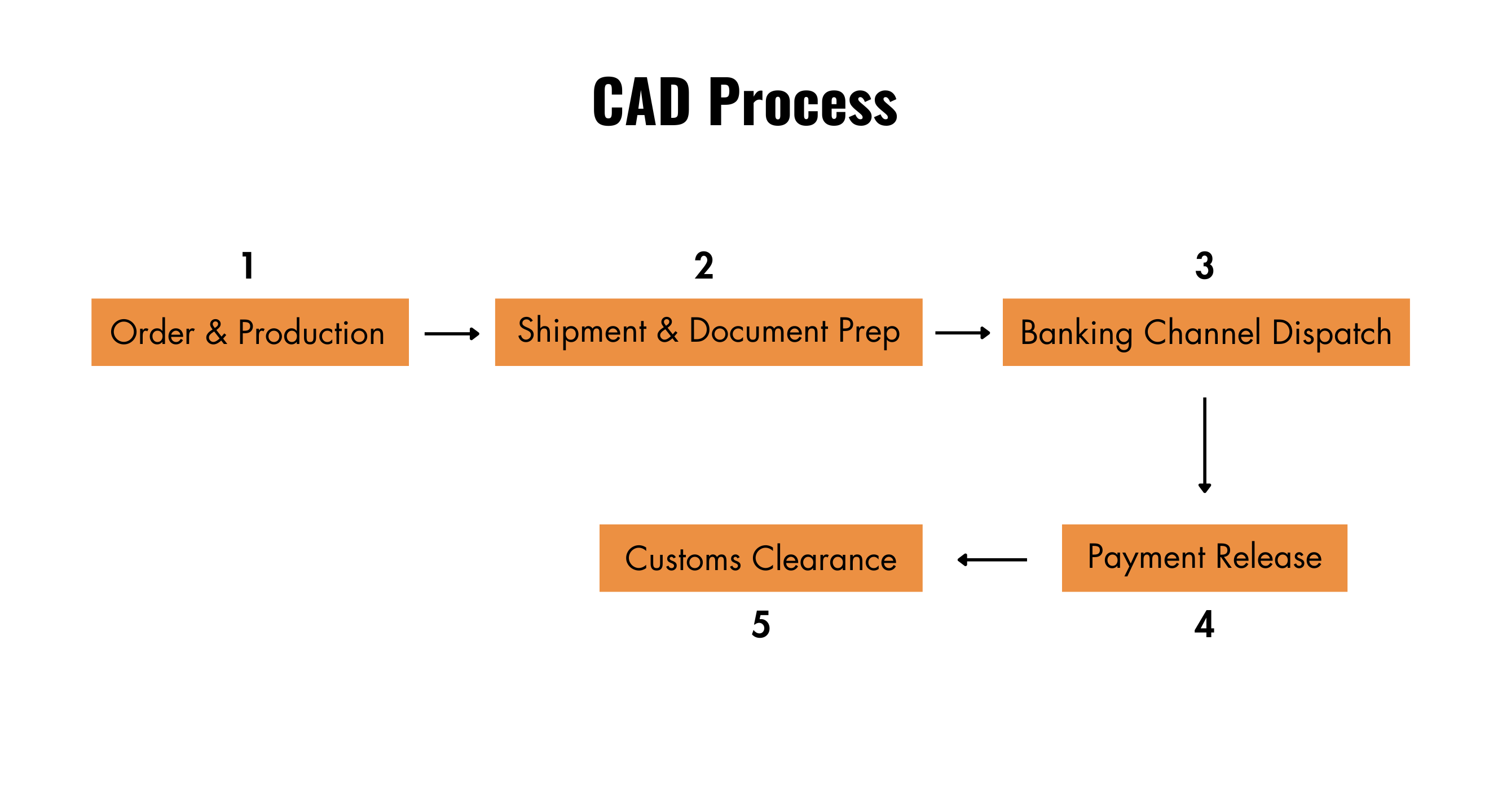
- Order & Production: The importer and the OEM flooring factory sign a contract specifying CAD payment terms. The factory extrudes, cuts, packs, and loads the container.
- Shipment & Document Prep: The factory loads the containers onto the vessel and collects all required export documentation:
- Bill of Exchange
- Export Collection Form
- Original Bill of Lading (B/L) (Document of title)
- Commercial Invoice & Packing List
- Other documentation
- Banking Channel Dispatch: The factory submits these documents to their bank (Remitting Bank), which securely forwards them to the importer’s bank (Collecting Bank).
- Payment Release: The importer’s bank notifies the buyer that the shipping documents have arrived. The buyer transfers the remaining invoice payment to the bank.
- Customs Clearance: Once funds are received, the collecting bank releases the original documents to the importer, allowing them to clear customs and claim their flooring containers at the port.
Pros and Cons of Using Cash Against Documents (CAD)
While Cash Against Documents (CAD) offers a well-balanced payment solution for global trade, like any international payment structure, it comes with its own set of advantages and limitations. Here is a clear breakdown of the pros and cons for both importers and exporters:
The Advantages
- Secure Payment Baseline: CAD provides a solid layer of security for the seller, ensuring that final payment is collected before the buyer can legally take possession of the goods.
- Opportunity for Pre-Shipment Inspection: In many structured CAD arrangements, buyers have the opportunity to inspect the cargo or review third-party quality control reports (like SGS testing) before releasing funds, verifying that the product meets agreed-upon specs out of the box.
- Streamlined Process: Compared to the rigid, document-heavy requirements of a Letter of Credit (L/C), CAD is vastly simpler and faster to execute for both parties.
- Cost-Effective Banking Fees: Transaction costs remain relatively low. Banks typically charge a modest service fee for handling the documentary collection, which is usually split evenly between the buyer and seller (unless stipulated otherwise in the sales contract).
The Disadvantages
- Risk of Transaction Cancellation: CAD does not force the buyer to accept the shipment. If the importer decides to walk away from the deal—due to market drops, local financial issues, or inspection disputes—the seller is left covering return freight costs while the container sits stranded at an overseas port.
- Banking Process Risks: Though rare, operational errors at the collecting bank can lead to documents accidentally being released to the buyer before full payment has been confirmed.
- No Bank Payment Guarantee: Unlike a Letter of Credit, the banks involved in a CAD transaction act strictly as facilitators—they do not guarantee payment or insure the transaction if the buyer defaults.
- International Transfer Fees: Standard cross-border banking fees and currency conversion costs can still add up depending on the financial institutions involved.
In conclusion
CAD provides a balanced, secure payment structure that protects your working capital while ensuring the factory has shipped your goods. Partnering with an established exporter like VN Ecofloor ensures your documentary collections move smoothly through the banking system, allowing you to scale your flooring brand with complete peace of mind.
Partner Smoothly with VN Ecofloor
Navigating international trade financing requires a transparent, financially stable OEM partner who understands global shipping and compliance. Operating as a premier export-focused manufacturer out of Vietnam since 2017, VN Ecofloor supports global importers, wholesalers, and commercial distributors with flexible, transparent trade terms tailored to long-term growth:
- Seamless Export Documentation
- Flooring Quality Guarantee: Every container of SPC and LVT flooring is extruded using 100% virgin polymer cores and precision click-lock milling, ensuring the physical product matches the exact specs listed on your commercial documents.
- Flexible Sourcing Solutions: From custom private-label box designs and specialized wear layers to acoustic backing options (IXPE/EVA), we work directly with your procurement team to structure safe, competitive payment and delivery schedules.
👉 [VISIT VN ECOFLOOR TO DISCUSS OEM TERMS]
Hotline/WhatsApp: +84 88 801 81 28
Official Website: vnecofloor.com
FAQs
- What is CAD payment in the flooring trade?
CAD, or Cash Against Documents, is an international payment method where the buyer can only receive the official shipping documents after making payment. In flooring trade, this means the importer cannot clear customs or collect the SPC/LVT container at the destination port until the payment is settled and the bank releases the original documents.
- Is CAD the same as Documents Against Payment?
Yes, CAD is often used in a similar way to Documents Against Payment, or D/P. Both terms refer to a documentary collection process where banks handle the shipping documents and release them to the buyer only after payment is made. The bank helps control the documents, but it does not guarantee payment like a Letter of Credit.
- How does CAD protect flooring exporters?
CAD helps protect the exporter because the buyer cannot take possession of the container without the original Bill of Lading and related shipping documents. This gives the factory more security than open-account payment terms, since the goods are already shipped but still controlled through the document release process.
- How does CAD benefit flooring importers?
For importers, CAD can be more flexible than paying 100% upfront. The buyer knows that the supplier has already shipped the goods before the final payment is released. In some cases, buyers can also review shipping documents, inspection reports, or product details before completing payment, which helps reduce sourcing uncertainty.
- Is CAD safer than T/T or L/C?
CAD sits between T/T and L/C in terms of risk and complexity. It is usually safer for the buyer than paying 100% in advance and simpler and cheaper than a Letter of Credit. However, CAD does not offer a bank payment guarantee, so both buyer and seller still need a trustworthy business relationship, clear contract terms, and accurate shipping documents.