

Vinyl flooring is one of today’s most popular and versatile flooring choices. However, when you have a marketplace overrun with the acronyms LVP, LVT, and SPC and also the wear layer, it can be difficult to know what you really want. What is vinyl flooring, and which type is right for you? This thorough review dematerializes all that you should know in terms of materials and types, from costs to advantages and disadvantages, so that you can make your final decision knowing what you are getting into.
Key takeaways
- What it is: Vinyl flooring is a durable, water-resistant, synthetic flooring made primarily from polyvinyl chloride (PVC). It is regarded as having multiple designs and durability.
- Principal categories: The followers are Luxury Vinyl Plank (LVP), which resembles wood; Luxury Vinyl Tile (LVT), which resembles stone or ceramic; and Sheet Vinyl, which is a smooth, low-cost surface.
- Vinyl planks and tiles: The core is crucial, as the core of a product largely defines its durability. The SPC (Stone Plastic Composite) cores are extremely tough and resistant to dents, while the WPC (Wood Plastic Composite) centers are lighter and produce less noise.
- Waterproof vs. Water-Resistant: The material used, the vinyl, is completely waterproof. Nevertheless, whether a waterproof installation is a success depends on preventing water from seeping through the seam to the subfloor.
- Price: depends on the type and quality of the material, with prices of between $0.50 and $7.00+ per square foot. Installation is an added value of $1.00 to 7.00 per square foot.
- Sensory Piece: The most significant ingredient to a long-lasting vinyl floor is a smooth and flat subfloor.
What is Vinyl Flooring?
At its core, vinyl flooring is a type of resilient flooring, meaning it has a certain degree of elasticity. It is also able to provide a little underfoot comfort, allowing one to stand on it longer than on relatively hard surfaces such as ceramic tile or stone.
Modern vinyl was initially popularized after World War II; it has since developed much beyond what you remember in the kitchen of your grandmother, in terms of patterned sheets. Due to unprecedented progress in the production process, the vinyl of the modern era can be virtually duplicated to become more reminiscent of premium quality natural compounds like hardwood and stone, at the same time being the most tenacious and resistant to water.

What is Vinyl Flooring made of?
The mystery of the quality performance of vinyl is the stratification of its structures and chemical substances. While the exact formula varies by product, most vinyl flooring is built from a few key ingredients:
- Polyvinyl Chloride (PVC) Resin: This is the foundation of vinyl flooring. PVC is a synthetic plastic polymer that is resistant to moisture, tough, and very versatile.
- Plasticizers: PVC, as it comes, is hard. Plasticizers are introduced to make the flooring supple and strong. The current and high-quality vinyl increasingly employs non-phthalate plasticizers to address high health and safety standards.
- Fillers include limestone (calcium carbonate) that is finely ground. It increases floor weight and density, resulting in more stability and dent resistance. In SPC flooring, the core has mainly limestone as a constituent.
- Pigments: The enormous selection of colors and choices of patterns is created by pigments.
- Fiberglass: Its layer is on several vinyl products, and the layer is essential in creating dimensional stability. This makes the flooring not expand, contract, or curve with variations in temperature and humidity.
A complicated process of manufacturing is done on these materials, where they are then combined and shaped into the final product, depending on the type of vinyl.
Types of Vinyl Flooring
Vinyl flooring primarily comes in three formats: Luxury Vinyl Plank (LVP), Luxury Vinyl Tile (LVT), and Sheet Vinyl.
-
Luxury Vinyl Plank (LVP)
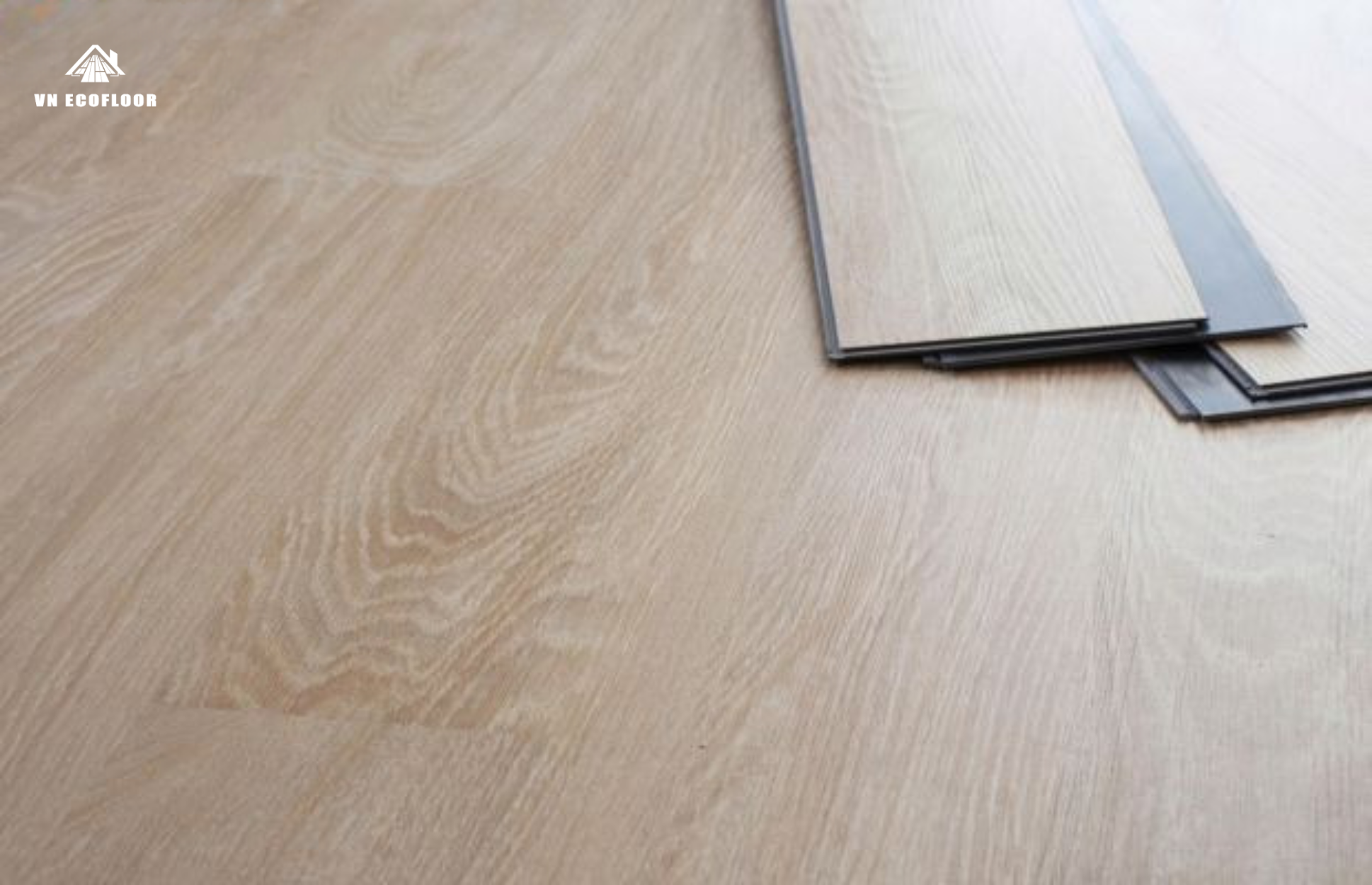
LVP flooring, as the name implies, is available in long planks to make it look like wooden planks. It creates photographic layers of high quality to determine the true grain, knots, and coloring differences of the wood species, such as oak, maple, and hickory. A significant number of high-end LVP items are also embossed-in-register (EIR) textured, with the surface texture being the exact visual representation of the wood grain, forming an unbelievably realistic appearance and feel.
LVP is very thick and tough as compared to sheet vinyl; thus, it is really durable. It comes in a click-lock system that is normally laid as a floating floor.
-
Luxury Vinyl Tile (LVT)

LVT has the same durable and multi-layered design as LVP; it is available in tile sizes (rectangle or square). It is meant to resemble a natural stone, such as marble, slate, travertine, or porcelain and ceramic tiles.
Comfort and convenience are the greatest assets of LVT compared to traditional tile. It is more forgiving, won’t break if an object is dropped on it, doesn’t need damming grout to install, and has no grout lines to clean and seal.
-
Sheet Vinyl

Large sheets of vinyl are in a roll format that is flexible (normally 6 or 12 feet in width). The best thing about it is that it can be fitted with few or no seams in most rooms. That is why it is very water-resistant and can be used in the bathroom and laundry areas.
Previously considered a budget product, the contemporary sheet vinyl has become available in the same realistic wood and stone finishes as LVP and LVT. It is even softer and not as hard as the luxury vinyl, but one can still decide it is an excellent material to use in case of the need to have a smooth, waterproof surface without spending a lot of money.
Comparative Analysis
To help you decide, here’s a quick comparison of the three main types of vinyl flooring:
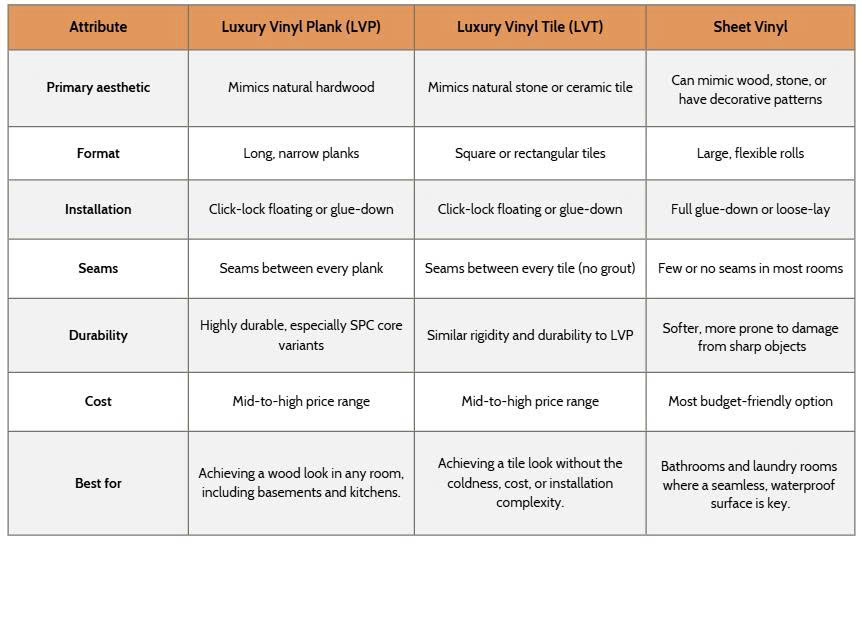
The Pros and Cons of Vinyl Flooring
Similar to any other flooring material, vinyl is characterized by a peculiar combination of strengths and weaknesses.
Pros:
- Lustrous IMC: High-quality vinyl is designed to be durable and scratches, scuffs, and stains are resisted in high-quality vinyl.
- Waterproof: Its synthetic structure has made it suitable when it comes to keeping wet water.
- Affordable: Vinyl usually provides the appearance of premium materials at a less expensive price.
- Low maintenance: The maintenance is easy; only simple sweeping and periodic damp mopping would be required to keep the place looking wonderful.
- Design flexibility: The design options are almost unlimited, from rustic wooden designs to modernity with concrete designs.
- Foot comfort: It is warmer and softer than tile or stone.
Cons:
- Hard to repair: Although it was very durable, damage may be difficult to fix. A broken plank may be substituted, and this may be complicated. For example, sheet vinyl is almost impossible to repair smoothly after a tear.
- Prone to fading: Vinyl is subject to fading, as with most types of flooring; long exposure to direct sunlight that is intense in nature causes the product to fade.
- Environmental issues: Since it is a PVC-based product, its environmental lifecycle is one of the considerations. Nevertheless, numerous honest manufacturers, such as VN Ecofloor, produce goods with the FloorScore certification that help them to comply with the high standards of indoor air quality and offer low levels of VOC (volatile organic compound) emissions.
How much does Vinyl Flooring cost?
The cost of vinyl flooring can vary significantly based on its type, quality, and thickness. This is a rough estimate with respect to market data provided by health publications such as Forbes and Home Depot.
-
Material cost per square foot
- Sheet Vinyl: $2.00+
- Luxury Vinyl Tile (LVT): $3.00+
- Luxury Vinyl Plank (LVP): $5.00+
A premium sheet vinyl can easily cost more than an entry-level LVP, so it’s more important to compare specifications than just the product type.
-
Installation and labour expenses
The installation cost could be increased by an average of $5 per square meter with professional installation. The overall cost will be determined by how the installation is done (click-lock vs. glue-down) and the state of your subfloor.
-
Ancillary costs
Other expenses to consider will include:
- Subfloor preparation: This is the largest variable. Subfloor leveling is an expensive endeavor.
- Old flooring: Maximus will need to tear up and dispose of old carpet or tile as an extra fee.
- Underlayment: When the vinyl you picked out does not include a pad as part of it, you will have to buy it separately.
- Trim and transitions: Baseboards and transition strips are required to complete the task in a professional manner.
Where does Vinyl Flooring work best in your home?
Thanks to its versatility, vinyl flooring is a wonderful choice for almost any room. Nevertheless, it really gleams in certain areas:
- Moorish locations: Its waterproof capability makes it the best option in the kitchen, bathrooms, laundry room, and basement.
- Heavy foot traffic areas: LVP and LVT are the best surfaces for entrances, corridors, and family rooms due to their durability, since they are used in places where children and animals are kept.

A glimpse of the top Vinyl Flooring brands
There are great brands in the market. VN Ecofloor boasts an excellent selection of the best choices to offer to its customers.
VN Ecofloor supplies high-quality LVT flooring designed to meet international performance and design standards. As a trusted OEM in Vietnam, the company ensures consistent quality, stable production capacity, and reliable lead times for global partners. With strict quality control at every stage and modern manufacturing facilities, VN Ecofloor delivers durable, stylish vinyl flooring solutions for both residential and commercial markets worldwide.
How to install Vinyl Flooring (Overview)
- Preparation of subfloor (the most important step!): The subfloor should be clean, dry and flat. All the dips should be filled by a flat material, and the bulgy parts should be rounded off.
- Acclimation: Acclimation of some products to the room temperature and humidity should take place within 48 hours prior to installation, but most current rigid core floors do not. Test the instructions given by the manufacturer.
- Installation:
- For click-lock LVP/LVT, planks are fitted to each other, and a small expansion gap is maintained on the room construct along the perimeter.
- For the glue-down vinyl, the planks or sheets are placed in the adhesive that is applied onto the subfloor. A heavy roller is then used to roll the floor in order to have a solid bond.
- Finishing: After the floor is laid, baseboards and transition strips will be installed to finalize the appearance.
Frequently asked questions (FAQs)
- Is vinyl flooring waterproof?
This is one of the major questions, and it has a subtle solution. Vinyl as a material, the planks, tiles or sheet are completely waterproof. An LVP plank can be submerged in water, where it will not be ruined.
But a complete installation can be no more waterproof than it seems. Although the tight-locking systems of modern LVP and LVT are very waterproof, there is still a probability of massive quantities of water leaking through the seams or around the edges of the room, which may cause damage to the wooden subfloor beneath. The topical waterproof protection is most adequate using the sheet vinyl, which has no seams.
Conversely, the older laminate flooring is built on a wood-fiber core, thus making it very prone to water damage. Although other more recent laminates can be touted as being water-resistant, they are not waterproof like vinyl. Vinyl is also safer in the case of bathrooms and basements.
- How long do vinyl floors last?
A quality vinyl floor lasts up to 10 to 25 years or even more when it is well-installed and maintained. The service life is directly proportional to the quality of the product, especially the thickness of the wear layer.
- How durable is vinyl flooring?
Modern vinyl flooring is extremely durable. The durability of vinyl flooring is determined by three key factors:
- Overall thickness: Planks with higher thickness (5 mm and above) are more robust and can tolerate small flaws in the underfloor.
- Wear layer: It is the protective top covering of the product, which is in mils. Most of the homes are advised to have a wear layer of 20 mil that is superior in terms of scratch and scuff protection.
- Core type: SPC (stone plastic composite) cores are the strongest ones and provide high resistance against dents due to heavy furniture or dropped objects.
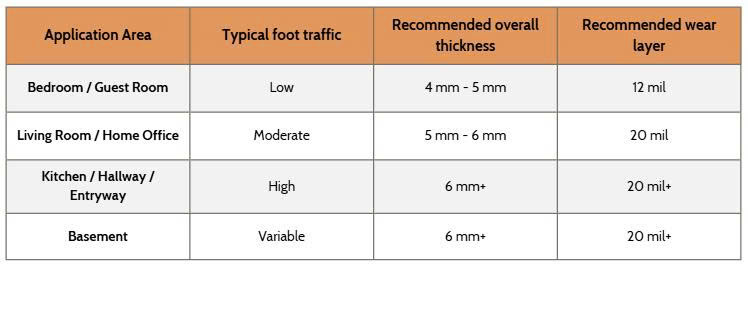
- What is a good thickness for vinyl flooring?
The best thickness depends on the application. Use this table as a guide:
- What is the best vinyl flooring?
The “best” vinyl flooring is the one that best meets the specific needs of your space and budget. No one can have the best product. To arrive at the most appropriate decision, consider:
- What will be the amount of foot traffic within the room? (It is your wear layer, determined by this.)
- Is it necessary to have maximum dent resistance for heavy furniture? (This points to an SPC core).
- Does one need comfort and silence underfoot? (A WPC core might be better.)
- What is my budget?
A combination of these will enable you to choose a floor that will serve you well in the years to come.