


In interior design, flooring plays a crucial role as the aesthetic and functional “foundation” of the entire space. In recent years, SPC (Stone Plastic Composite) flooring has become a top choice thanks to its perfect combination of the durability of stone and the beauty of wood. However, a question that always puzzles consumers is, “Does thickness really matter? What thickness is sufficient?”
The resounding knowledge is yes, but it is not only a number. The correctness of choosing the right thickness involves balancing the requirements of your project, your budget, and the life of the floor.
1. What is SPC Flooring and Why Is It So Popular?
The acronym SPC Flooring is used to refer to Stone Plastic Composite. It has a special hard core that is manufactured using a mixture of natural limestone powder, polyvinyl chloride (PVC), and stabilizers. This particular equation designs an extremely thick and solid plank.
Why is it the global favorite?
- 100% Waterproof: SPC will not swell or peel when it comes in contact with moisture, as opposed to laminate or hardwood.
- High Stability: The presence of a stone core implies that it will not change considerably in height or temperature.
- Eco-Friendly: The SPC floors are of good quality and contain no phthalates, and they are safe in terms of indoor air quality.
- Versatile Aesthetics: The use of new printing technology enables the use of textures that can resemble real oak, marble, or slate.
SPC flooring is offered in 2 principal types:
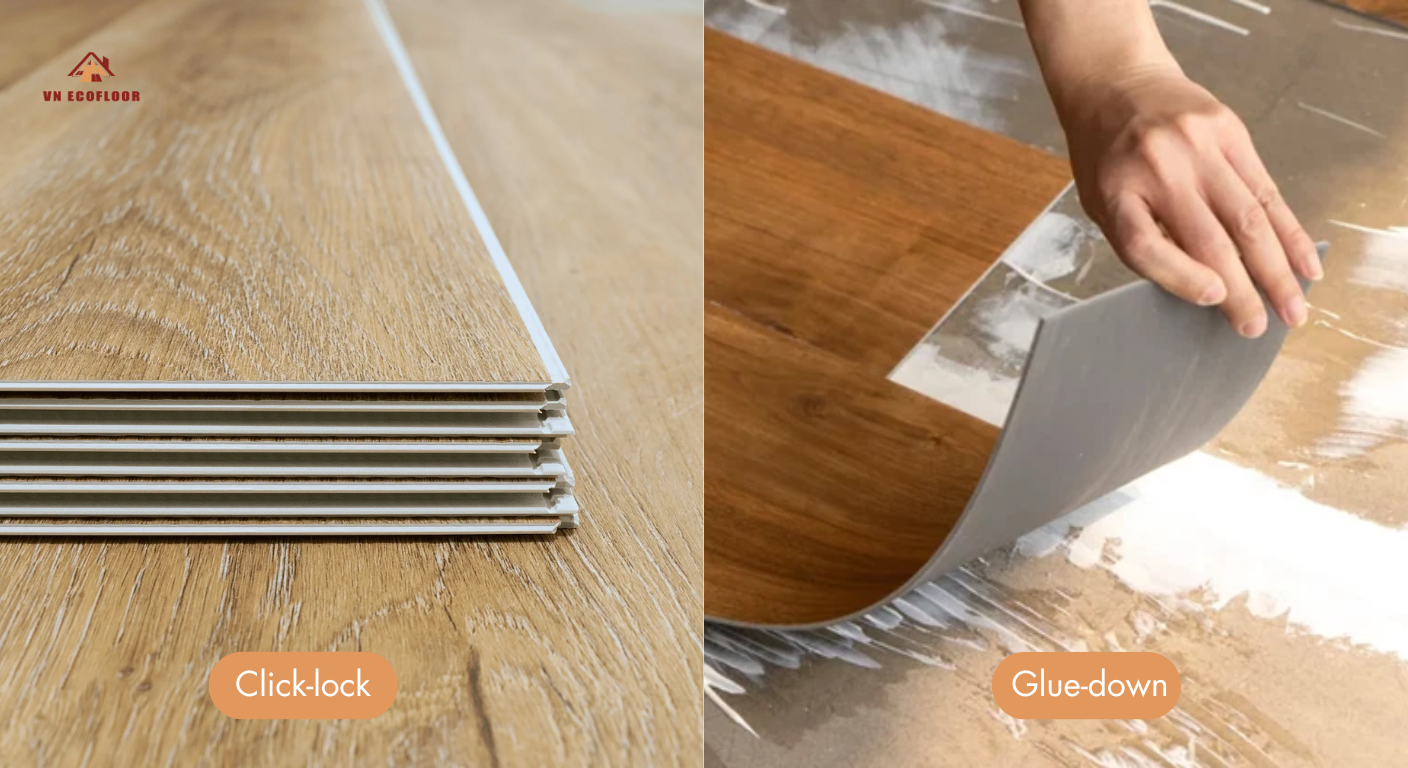
- SPC Click-Lock: The floor panels are joined together using a tongue-and-groove system, requiring no glue. This is the number one choice for modern projects.
- SPC Glue-Down: Use specialized adhesive to secure the flooring panels to the subfloor. This type is typically thinner and requires an extremely flat subfloor.
2. Understanding Thickness in mm vs. Mil: Why It Matters
We discuss two measures in the SPC world. To make a smart purchase, it is essential to know the difference:
- Total Thickness (mm): this is the sum of the total plank sandwich: integrated padding (IXPE/EVA) + rigid core + wear layer. The mm of the thickness usually provides a more reliable locking mechanism and firmer underfoot.
- Wear Layer Thickness (Mil): The designation “mil” (thousandth of an inch) is used to measure the thin covering of the design that shields it against scratches. Whereas the mm is used to offer structural integrity, the mil as offers surface protection.
Why does thickness matter? A heavier core will have a better area in which a strong click-lock system can fit. When a plank is not thick enough to support a certain setting, it can very well have a weak link when a lot of pressure is applied or on an uneven subfloor.
3. SPC Flooring Thickness Guide: How to Choose the Right Option
3.1 SPC Click-Lock Flooring
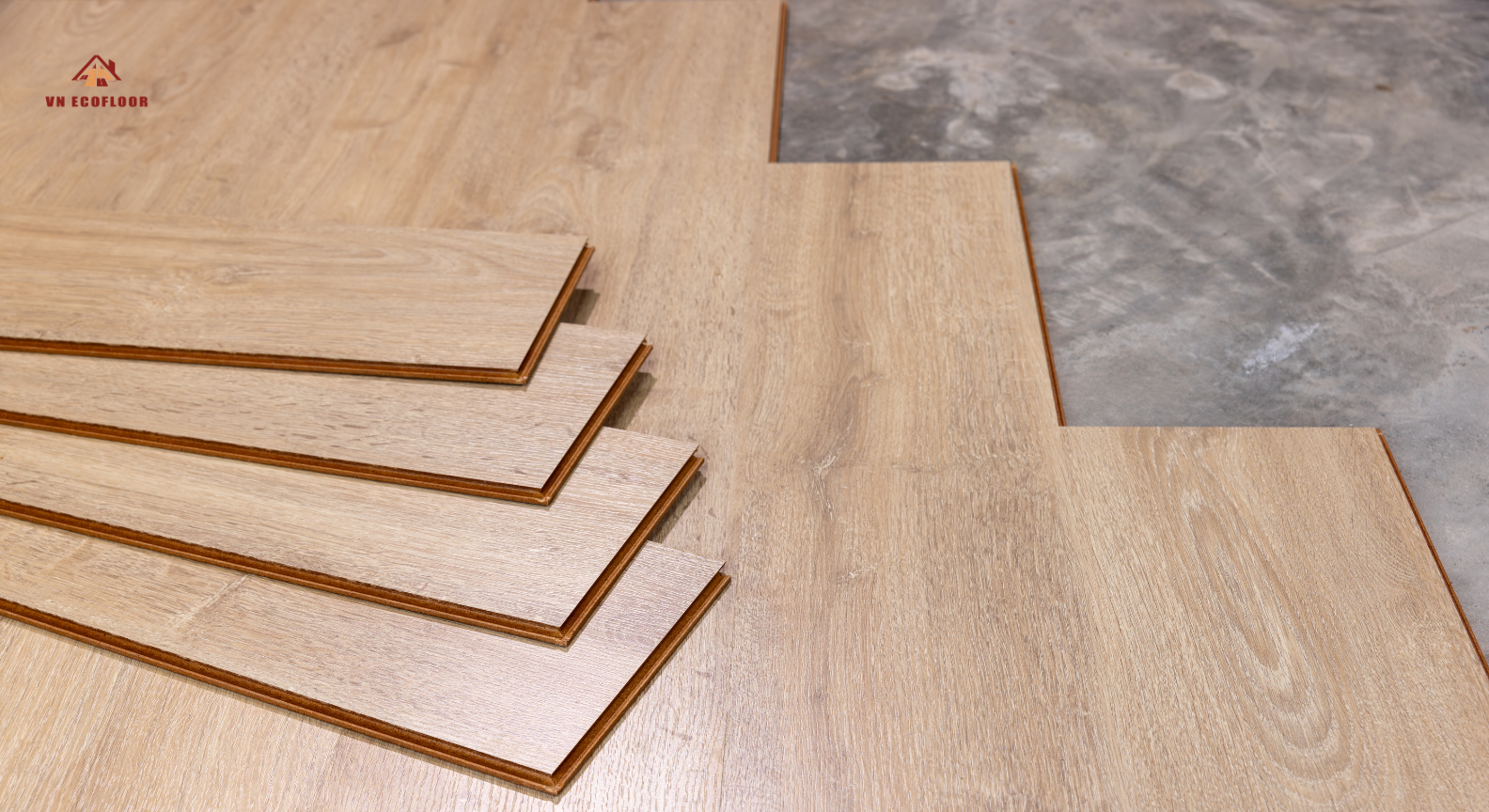
Click-lock is the most popular choice for both residential and commercial renovations due to its glue-free application.
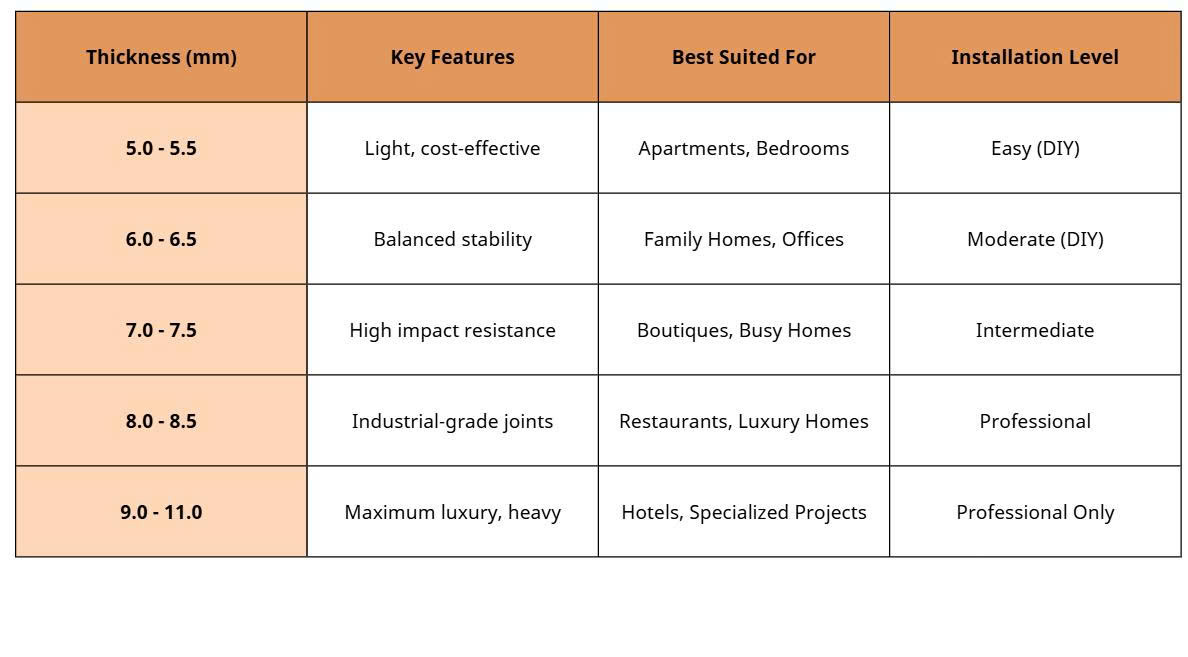
+ 5mm – 5.5mm
- Suitability: Residential, apartments, and bedrooms.
- Durability: Best used in ordinary foot traffic. Guarantees complete protection against water.
- Installation: Extremely DIY. The boards are thin and easy to cut. But it needs an absolutely flat subfloor, as the thinner fixing system is not so tolerant of depressions.
- Features: Typically has a 1mm IXPE foam backing, which is used to provide simple sound damping.
+ 6mm – 6.5mm
- Suitability: Residential homes with households, kids, or minor home businesses.
- Durability: An increment on stability. The core is also thick so that it can have a deeper, more secure click-lock.
- Installation: Accessible to a lot of DIY. It is able to conceal very slight defects in the subfloor better than the 5mm one.
+ 7mm – 7.5mm
- Suitability: busy residential or light commercial real estate places, such as boutiques.
- Durability: high impact strength. Able to move heavy furniture without telegraphing (subfloor localized unevenness) when doing it.
- Installation: DIY / Professional. Planks are less suitable for snap cutting. They should have a clean finish that requires professional tools (such as a flooring cutter).
+ 8mm – 8.5mm
- Suitability: The commercial high traffic, restaurants, and upmarket houses.
- Durability: The standards of the Gold Standard. The joints are extremely robust, and hence it is not vulnerable to heavy rolling loads.
- Installation: Professional Advocated. The life of the boxes is heavy. Their planks are also stiff and, therefore, difficult to bend into small corners without professional knowledge.
+ 9mm – 9.5mm
- Suitability: Commercially high-end buildings or vast open-plan buildings.
- Durability: Exceptional. Provides a more solid, premium underfoot feel, closer to hardwood when paired with high-density underlayment.
- Installation: Pro Only. Air needs to be cut precisely and heavily. The locking system is quite high, and it needs special tap blocks and skills to lock it without any loopholes.
3.2. SPC Glue-Down Flooring
Glue-down options are thinner because they don’t need a click-lock profile, but they require a permanent bond.
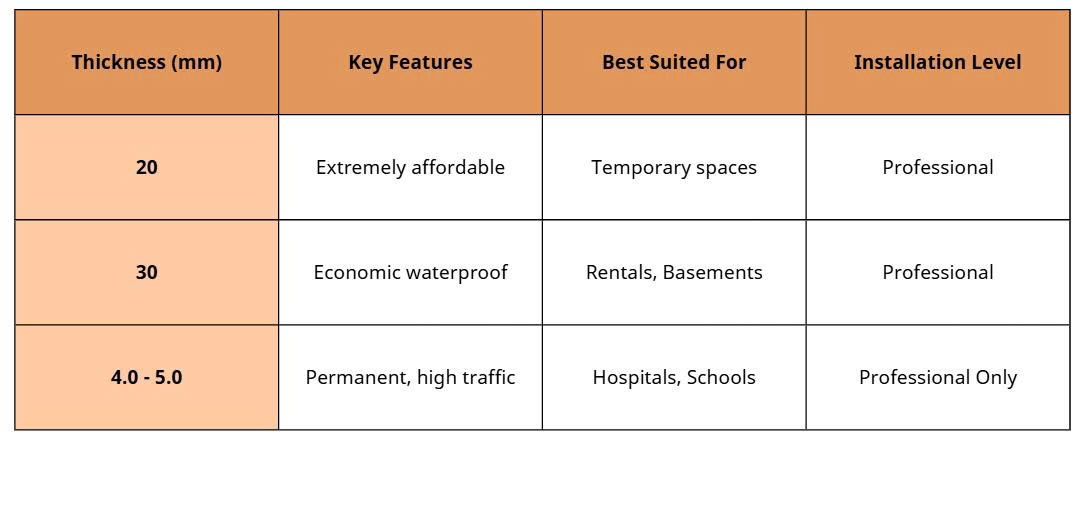
+ 2mm
- Suitability: Temporary makeovers, pop-up stores, or storage.
- Durability: Entry-level performance with limited impact resistance. Due to the thin profile, any imperfections in the subfloor (waves, joints, or unevenness) may telegraph through the surface if not properly prepared.
- Installation: Professional installation is strongly recommended. Requires a perfectly smooth, skim-coated, and level subfloor, along with strict adhesive application control. DIY installation is not advised, as corrections after adhesive curing are difficult and costly.
- Key Notes: This thickness is commonly categorized as dry-back LVT or SPC-based vinyl rather than rigid-core SPC. Best suited for low-load environments where ease of replacement and short lifecycle use are expected.
+ 3mm
- Suitability: Residential rentals or low-traffic work offices, which should be affordable.
- Durability: Moderate. Has all the rights to be considered totally waterproof, yet does not have an underfoot cushion.
- Installation: Professional. Needs the ability to lay the glue so that it doesn’t have bubbles or imbalanced planks.
+ 4mm
- Suitability: General office buildings and health care institutions.
- Durability: More dimensionally stable, but still requires a properly prepared subfloor.
- Installation: Professional. At the thickness, the planks have increased weight; to provide an even bond spanning a large floor plate, it takes rollers and sticky glues of professional standard.
Conclusion
Choosing the thickness of SPC flooring isn’t about “the thicker the better,” but rather “what best suits your needs.”
If you live in an apartment and want to beautify your home yourself, 5mm – 6mm, click-lock is the smartest choice.
If you’re investing in a long-term commercial space, feel free to choose 7mm or thicker.
And don’t forget: The Wear Layer (Mil) protects the floor from scratches, while the thickness (mm) protects the floor’s structure.
We are also proud to be in VN Ecofloor, a leader in the production of SPC flooring in Vietnam. Having 9 years of experience in exporting products globally, we have honed our technology to the highest standards of international product exporting. We not only manufacture flooring, but we also create strong, environmentally friendly foundations for homes and businesses all over.
Do you have a new project in mind? We should be happy to assist you in selecting the ideal thickness for your space. Would you prefer me to give you a quote that is personalized, or would you like me to give you an online portfolio of our latest designs? Please get in touch with the hotline/WhatsApp: 088 801 81 28.
FAQs
- Can I install 4mm interlocking flooring over old tiles?
Yes, but the tiles must be extremely flat. If the grout is too deep or the tiles are bulging, you should choose a 6mm or thicker option to avoid damaging the interlocking system.
- Why is 8mm flooring so much more expensive than 4mm?
Because it contains twice the amount of stone powder and PVC resin, the shipping costs are higher, and the interlocking system requires more precise cutting.
- Is wear layer thickness more important than total plank thickness?
Both matter, but they serve different purposes. Total thickness (mm) affects structural strength and locking stability, while wear layer thickness (mil) determines scratch resistance and surface durability. For long-term performance, both should be selected based on usage requirements.