


Looking for the perfect floor? Laminate flooring offers the timeless beauty of hardwood without the hefty price tag. But to know if it’s the right choice for your home, you first need to understand: What is Laminate flooring? This complete guide breaks down its layers, costs, and key pros and cons to give you a clear answer.
Key takeaways
What it is: Laminate flooring is a durable, multi-layer synthetic flooring that mimics the appearance of wood or stone using a decorative film layer.
Cost-effective: It’s a budget-friendly alternative to hardwood, with total project costs typically ranging from $3 to $13 per square foot, depending on quality and installation.
Highly durable: Thanks to a tough wear layer, laminate is exceptionally resistant to scratches, stains, and fading, making it ideal for high-traffic areas and homes with pets and children.
DIY-friendly: The click-lock installation system makes it one of the easiest flooring types for DIY projects.
Key weakness: Traditional laminate is susceptible to moisture damage and it cannot be refinished like real wood. However, modern waterproof options are now widely available.
Performance matters: Look for the AC rating (Abrasion Class) to determine durability (AC3 or higher is recommended for most homes), and consider thicker planks (10-12 mm) for better stability and feel.
What is Laminate flooring?
Laminate flooring is a synthetic, composite flooring product made up of multiple layers fused through a lamination process. Its core is typically made of high-density fiberboard (HDF), which gives it stability and strength.
What makes laminate so versatile is its design layer, a highly detailed, decorative film layer of a natural material like wood or stone. This image is protected by an extremely durable, clear topcoat. The result is a floor that captures the aesthetic of expensive natural materials while offering its own unique set of performance benefits. It’s often called a “floating floor” because the planks connect with a click-lock system, rather than being nailed or glued to the subfloor.

How is Laminate flooring made?
Understanding how laminate is constructed is key to appreciating its durability. Every plank consists of four distinct layers that are fused using high heat and direct pressure.

The wear layer: This top, transparent layer is the floor’s first line of defense. Made from a tough melamine resin fortified with aluminum oxide, it’s what makes laminate so resistant to scratches, stains, impacts, and UV fading.
The design layer: This is where the magic happens. A highly realistic, 3D photograph of wood grain or stone texture is printed on this layer, giving the floor its look. Advanced manufacturing ensures the pattern is varied to avoid repetition.
The core layer: The heart of the plank, this layer provides structure and stability. It’s made from high-density fiberboard (HDF), an engineered wood product known for its strength and impact resistance. The click-lock system is milled directly into this core.
The backer layer: This bottom layer provides stability and a crucial moisture barrier from the subfloor. It balances the plank, preventing it from warping or cupping over time.
The pros and cons of Laminate flooring
Like any material, laminate has its strengths and weaknesses. A balanced view is essential.
The advantages (Pros)
- Affordability: This is laminate’s biggest selling point. It offers the look of hardwood for roughly half the cost, making it a fantastic choice for budget-conscious homeowners.
- Exceptional durability: Laminate is built to withstand busy households. It’s tough wear layer resists scratches from pets, scuffs from shoes, and dents from furniture better than many solid hardwoods.
- Easy DIY installation: The click-lock floating floor system is a game-changer for DIYers. It significantly reduces or eliminates professional labor costs.
- Low maintenance: No waxing or polishing required. Regular sweeping and occasional cleaning with a damp mop are all it takes to keep the laminate looking great.
- Design versatility: With endless high-resolution designs, you can achieve virtually any look, from rustic oak to modern marble, without the associated cost or upkeep.
- Allergy-friendly: Unlike carpet, laminate’s solid surface does not trap dust, dander, or other allergens, contributing to better indoor air quality.
The disadvantages (Cons)
- Moisture susceptibility: The HDF core is a wood product. If water seeps into the seams, it can cause the planks to swell and warp. While modern waterproof laminate flooring has greatly improved this, prompt cleanup is always a must.
- Authenticity and feel: While visually convincing, it doesn’t have the same warmth or feel as real wood. It can also produce a hollow sound if installed without a quality underlayment.
How much does Laminate flooring cost?
The total cost of a laminate flooring project depends on the material quality, labor, and other supplies.
-
Material cost
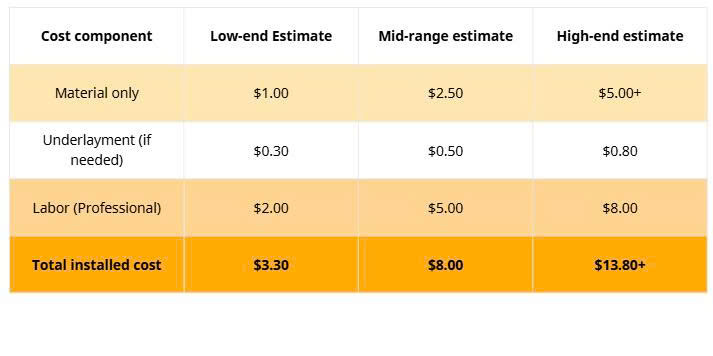
The planks themselves typically range from $1 to $6 per square foot. This price is influenced by:
- Thickness: Thinner 6-8 mm planks are cheaper, while premium 10-12 mm planks offer better stability and feel, costing $2.30 to $6.00 or more per square foot.
- Finish: Advanced textures that mimic real wood grain (embossed-in-register) cost more than simple smooth finishes.
- Durability (AC rating): A higher AC rating means a more durable (and more expensive) wear layer.
- Special features: Waterproof cores and pre-attached underlayment pads also add to the cost.
-
Installation cost and other expenses
- Professional labor: If you hire a pro, expect to pay $2 to $8 per square foot for installation.
- Underlayment: This is essential for sound insulation and moisture protection. It costs around $0.30 to $0.80 per square foot if not already attached to the planks.
- Other costs: Don’t forget to budget for old flooring removal ($400-$600 for a 200 sq. ft. room) and potential subfloor repairs.
-
Total project cost
Combining materials and professional labor, the average installed cost for laminate flooring is $3 to $13 per square foot. A basic DIY project can be on the lower end, while a premium, professionally installed waterproof floor will be on the higher end.
Laminate flooring cost estimation (per sq. ft.)
Quick comparison with other flooring types
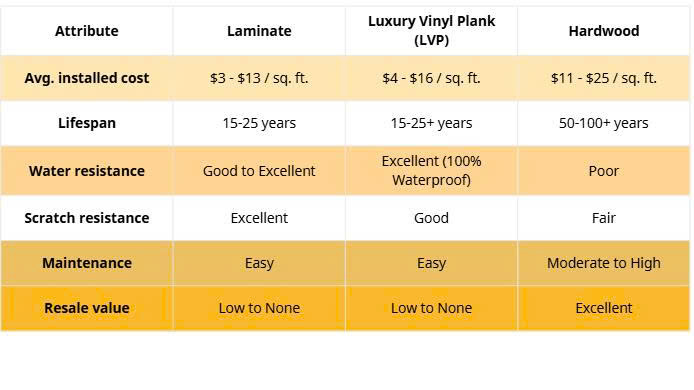
Laminate vs. Luxury Vinyl Plank (LVP): It is the most similar one. LVP is a safer choice, as it can be fully used in the bathroom and basement, as it is 100% waterproof with its core being made out of plastic. Nevertheless, laminate can provide a more natural wooden appearance and higher resistance to scratches.
Laminate vs. Hardwood: The hardwood is the real thing, and it is the long-term investment that gives a substantial resale value to a house and can be refinished several times. A more viable option is Laminate, which is cheaper and more practical for daily use, as it is more resistant to scratches and stains but cannot be refinished
Flooring comparison overview
 .
.
Where does Laminate flooring work best in your home?
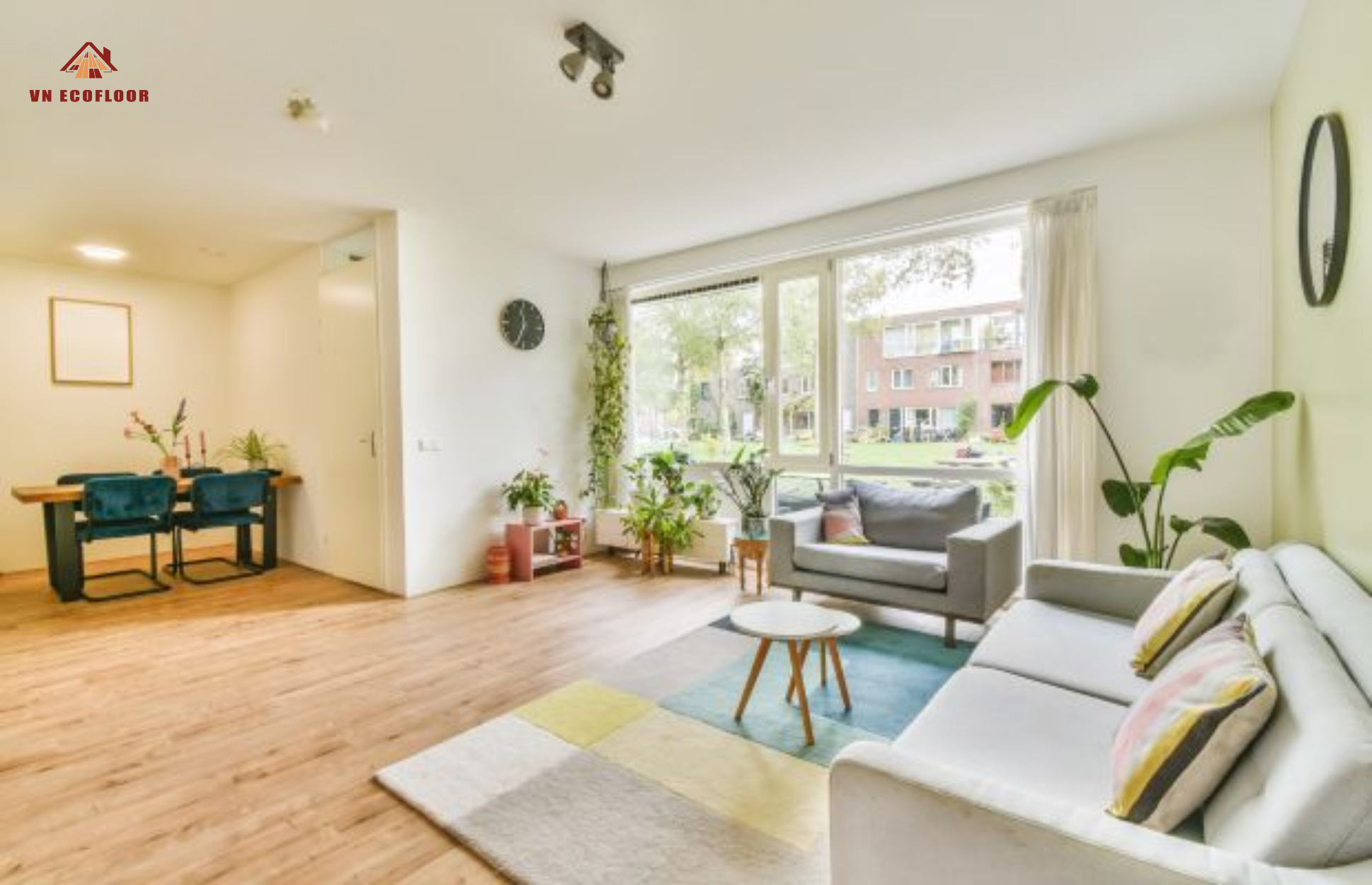
Ideal locations: Perfect laminate should be used in a living room, bedrooms, corridors, and home offices. It is long-lasting and can withstand traffic, and its design has been able to suit any decoration.
Caution: Kitchens and half-baths may be used with modern water-resistant or waterproof laminate, although spills are still to be cleaned up.
Avoid (or use in waterproof mode only): Bathrooms and basements are very risky, as they are prone to it. In these places, one would only think of the best waterproof laminate that has a perfect, constantly sealed installation, and 100 percent waterproof vinyl can be quite safe.
A glimpse into the top Laminate flooring brands
Innovators dominate the market, and they have advanced laminate technology. Such brands as Pergo (the creator of laminate), Mohawk, and Shaw can be characterized by their strong mechanisms of waterproofing (such as WetProtect) and a high level of scratch resistance. Other important competitors, such as Mannington and AquaGuard, are all high-performance oriented with extended water-resistant warranties and high duration rates.
In making the purchase decision, you should concentrate on the technology that will suit you, such as the high AC rating so that it lasts longer or a particular waterproof system because it fits in a kitchen, and not the brand name.
How to Install Laminate Flooring
The click-lock technology of Laminate renders Laminate a well-liked DIY project. Preparation is the key to success.
- Flooring: Pick up the unopened boxes and leave them in the room for at least 48-72 hours to get used to the temperature and humidity. Failure to do this may result in buckling in the future.
- Subfloor setup: This should be dry and clean and exactly level. Fill low areas and sand high areas.
- Install the underlayment: Unroll the underlayment, with a vapor barrier rolled out between the rolls over the concrete first.
- Fit up the planks: Commence all around the length of the longest wall, reserving a 1/4-in. expansion room along the side. Clamp the planks together with staggered rows of the seams to make it very strong and appear natural.
- Complete the work: The final row to be finished is by use of a pull bar, followed by baseboards to seal the expansion gap.
Frequently Asked Questions (FAQs)
1. What is an AC3, AC4, AC5 rating for Laminate flooring?
Durability is measured by the AC (Abrasion Class) rating. AC3 can be used in heavy residential areas (anywhere around the house). AC4 is a light commercial model and an excellent, highly enduring model to choose for any house. AC5 is in heavy commercial traffic, and it is the most durable.
2. What is the average cost to install Laminate flooring?
The cost of materials and professional labor ranges between 13 and 3 dollars per square foot on average. A room that is 200 square feet in size could cost between $1,000 and $2,150 to install Laminate flooring.
3. Is Laminate flooring waterproof?
All Laminate are waterproof. The conventional laminate is prone to water damage. Nevertheless, a large number of current products are promoted as waterproof or water-resistant, comprising water-tight seals and a water-resistant core capable of withstanding spills during a certain period of time (e.g., 24-72 hours).
4. How thick is Laminate flooring?
The thickness of the laminate varies from 6 mm to 12 mm. Although 8 mm is a standard, heavier 10 mm or 12 mm planks are more stable, more solid to walk on, and will conceal minor imperfections in the underlying surface.
The final verdict: Is Laminate flooring right for you?
Laminate flooring offers an unbeatable combination of durability, style, and value. It is the ideal answer for homeowners seeking the classic appearance of wood or stone but rationalizing that the surface must endure the daily demands of everyday living without being overwhelmingly expensive.
Although it may not be as refinishable or even as resellable as real hardwood, its utility cannot be disputed. Modern laminate is more than ever an appealing and flexible product with the introduction of beautiful and true-to-life designs and the powerful waterproofing technology.