

Kitchens and bathrooms are the heart and soul of any home, but they are also the most demanding environments for your floors. Between steaming showers, splashed dishwater, and the occasional plumbing mishap, these high-moisture areas require more than just a pretty surface. They need a floor that can survive a flood.
Choosing the best waterproof flooring for kitchens and bathrooms is a critical decision for homeowners and interior designers alike. Not all “water-resistant” floors are truly waterproof—and choosing the wrong one can cost you more in repairs and mould remediation than the original installation.
In this guide, we’ll break down the top waterproof flooring options, compare modern materials like SPC flooring’s waterproof technology against traditional tiles, and help you make an investment that lasts a lifetime.
1. What Makes Flooring Truly Waterproof?
Before you browse samples, it’s vital to understand the waterproof flooring definition. The market is filled with products that are supposed to manage moisture, but there exists a huge technical distinction between “resistant” and “proof.”
1.1 Waterproof and Water-Resistant
Water-Resistant: The substance is resistant to liquid on its surface in the short run (typically 24-72 hours). But when the water leaks into the joints or when it remains in a wet condition, it will cause the core to swell, warp, or become moldy.
Waterproof: The material in itself is either chemically or structurally impervious to water. The floor will not swell; it will retain its structural integrity even when submerged or exposed to high moisture levels over a period of weeks, such as SPC flooring that is really waterproof.
1.2 Key Criteria for Wet Areas
To be suitable for kitchens and bathrooms, a floor must possess the following:
- Non-absorbent core: typically composed of stone-plastic composites or high-grade resins.
- Dimensional stability: It should control swelling or shrinking in case you accidentally drop a hot pot of soup from your stove.
- Resistance to Mold and Mildew: It is made of organic materials, such as wood, which rots; waterproof floors should be made of inorganic materials.
- Watertight seams: The system should also be tight enough that water cannot get to the subfloor.
2. Key Factors to Consider Before Choosing
Keep these five considerations in mind when selecting waterproof flooring for a kitchen or bath:
- Slip Resistance: These are splash zones (in the bathroom). It has a slip rating of either R10 or R11 to avoid accidents on wet surfaces.
- Longevity: Kitchens are busy places. Your floor must be able to support dropped pots, moving chairs, and heavy appliances.
- Installation Speed: Would you like a 3-day tile installation or a 3-hour click-lock installation?
- Maintenance: Is it possible to wash it using a plain, wet mop, or does it need special sealants and grout washes?
- Long-term Cost: A less expensive floor that goes out of shape in only two years costs way more than a high-quality, waterproof floor worth twenty years.
3. Best Waterproof Flooring Options: Ranked
3.1 SPC Flooring (Most Recommended)
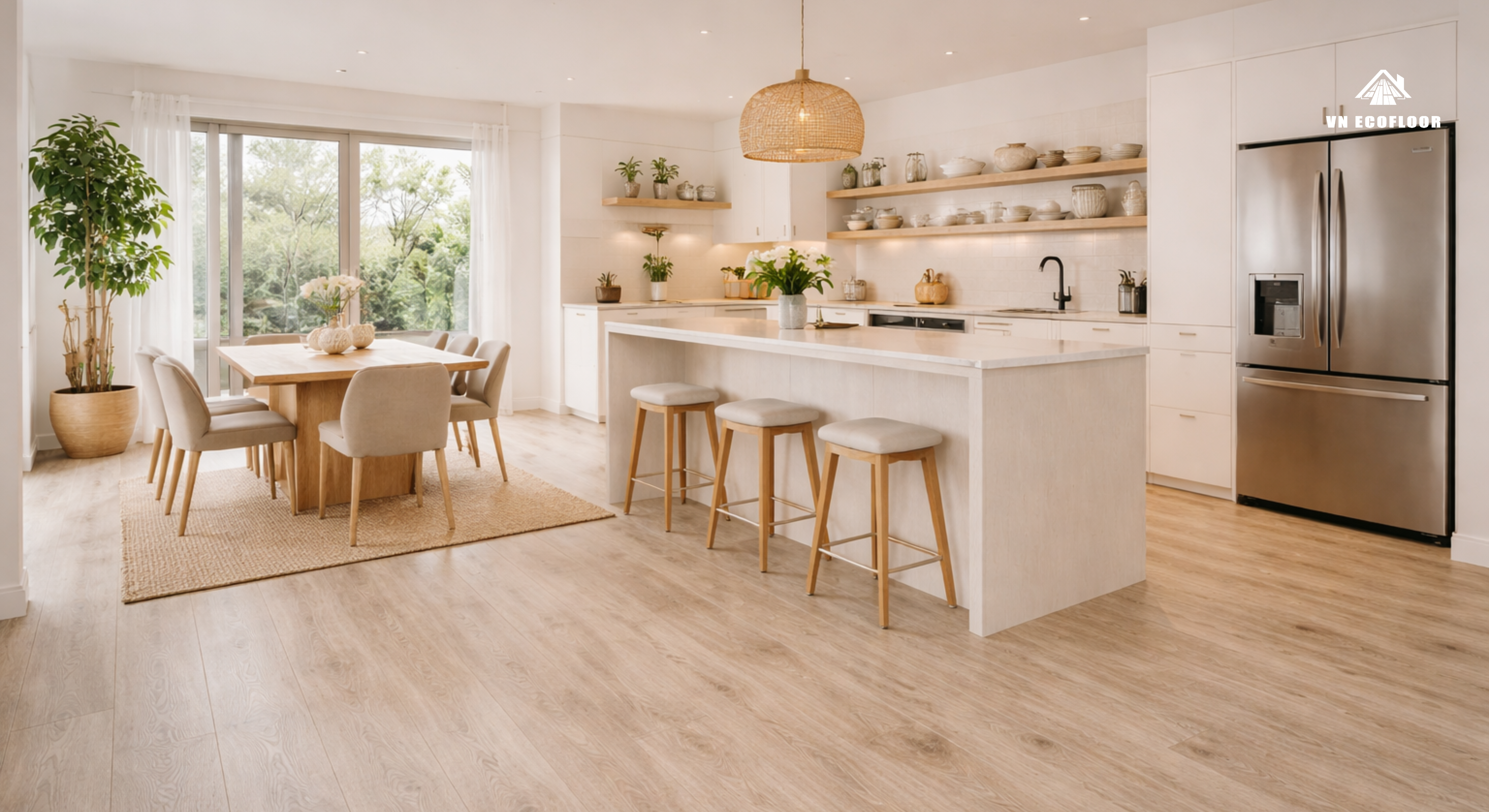
SPC (Stone Plastic Composite) flooring’s waterproof technology is currently the gold standard. Made from a mix of natural limestone powder and polyvinyl chloride, it is 100% inorganic.
What makes it the best: It has a rigid core that is completely against swelling. It is also very resistant to changes in temperatures that prevail in kitchens and bathrooms (up to 80℃ ).
Insight: “SPC is currently the most reliable waterproof flooring for modern homes, offering the look of wood with the resilience of stone.”
3.2 Vinyl Flooring (LVT)
Vinyl flooring for wet areas has been a staple for years. It is made from synthetic materials, making it naturally immune to water damage.
Advantages: Most comfortable to stand on and can be of infinite designs.
Cons: Traditional LVT is not as tough as SPC; hence, it would imprint indentations of heavy kitchen appliances over time.
3.3 Tile Flooring
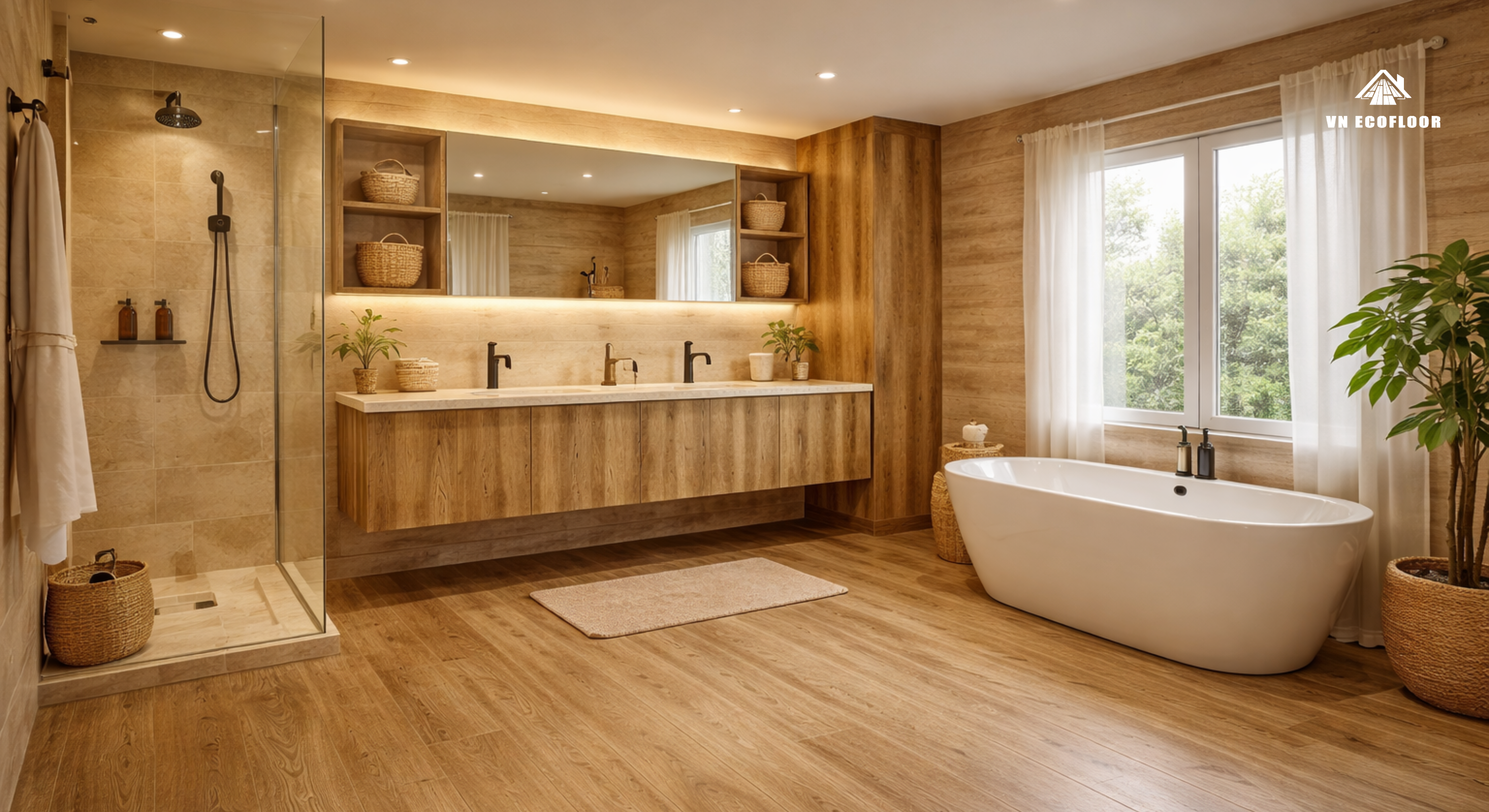
Traditional tile flooring for bathrooms is the classic choice.
Advantages: It is totally waterproof and incredibly tough.
Cons: the grout lines are porous and will take in dirty water/bacteria. Tiles, too, are cold and difficult on the joints, not to mention that they are not only slippery when wet but can also be quite dangerous.
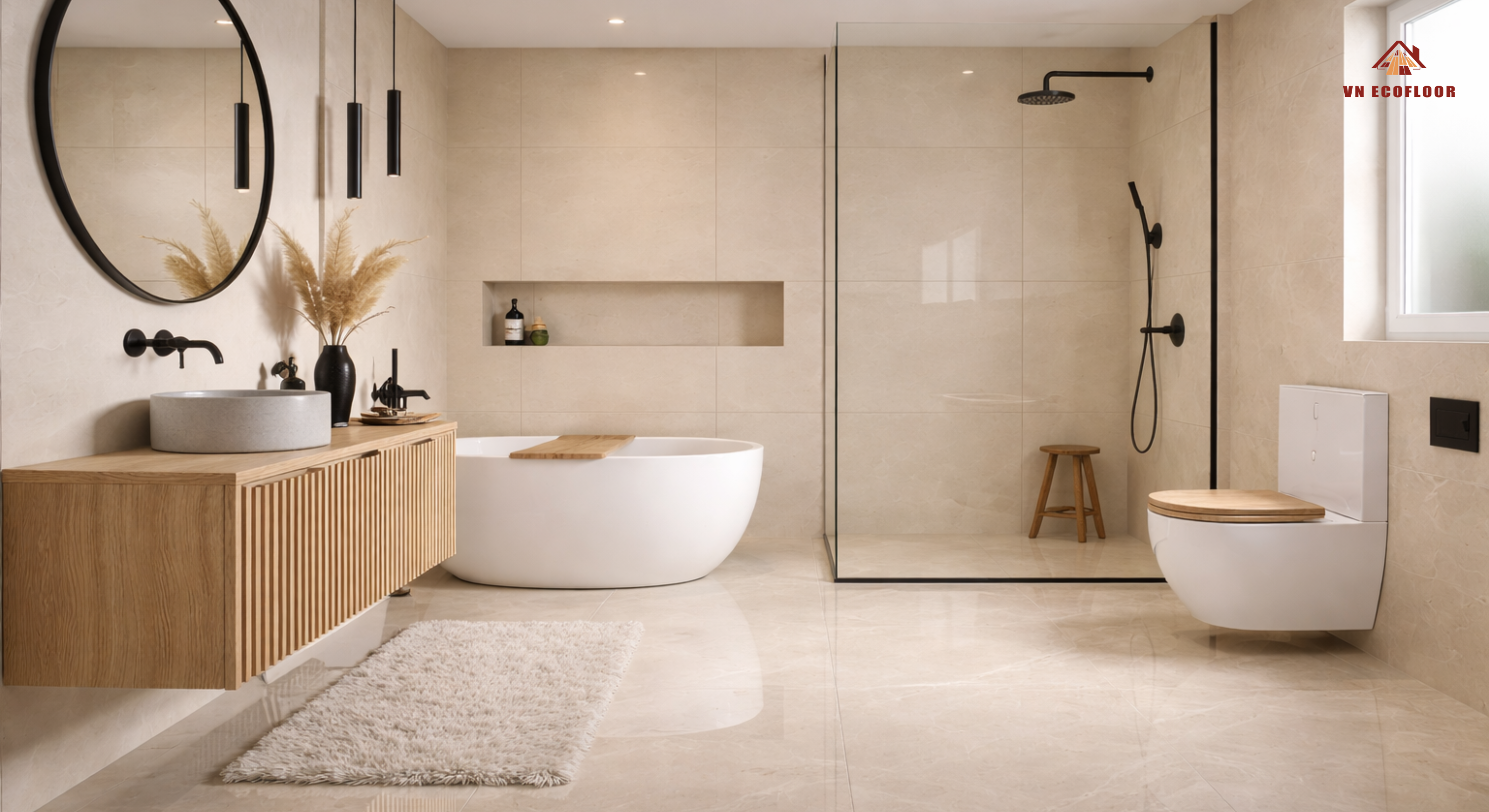
4. SPC vs. Tile: Which Is Better for Wet Areas?
For decades, tile was the only option for bathrooms. Today, waterproof SPC vs. tile is the big debate.
| Feature | SPC Flooring | Ceramic/Porcelain Tile |
|---|---|---|
| Waterproof Level | ⭐⭐⭐⭐⭐ | ⭐⭐⭐⭐⭐ |
| Slip Resistance | ⭐⭐⭐⭐⭐ (Textured) | ⭐⭐⭐ (Slippery when wet) |
| Comfort/Warmth | ⭐⭐⭐⭐ (Warm) | ⭐ (Cold & Hard) |
| Installation | Easy (Click-lock) | Complex (Mortar & Grout) |
| Maintenance | Low (No grout) | High (Grout cleaning) |
5. Common Mistakes to Avoid
- Installing Laminate in Bathrooms: Even “water-resistant” laminate often fails in the high-humidity environment of a bathroom.
- Neglecting Slip Ratings: A floor with no texture is dangerous, even though it is waterproof.
- Prefer Water-Resistant to Waterproof: 100 percent waterproof material does not have an alternative in a kitchen or bathroom.
- Bad Subfloor Preparation: A floor, even to a great extent, requires a level base to keep the locking systems unbroken by water.
6. Why SPC Flooring Is the Ultimate Waterproof Solution
Beyond just stopping water, SPC flooring fits the modern lifestyle:
Truly waterproof: You can place an SPC plank actually in water and leave it for a week, and it does not get out of shape.
Thermal Stability: It is sturdier than it seems and can withstand both the heat of a kitchen and the humidity of a bathroom.
Ease of Living: It is pet-friendly, scratch-resistant, and can be directly overlaid upon the majority of existing hard floors.
7. Discover the VN Ecofloor Difference
When it comes to the best flooring for high moisture areas, quality manufacturing is everything. VN Ecofloor is a global leader in high-performance SPC technology.
Why Choose VN Ecofloor Waterproof Flooring?
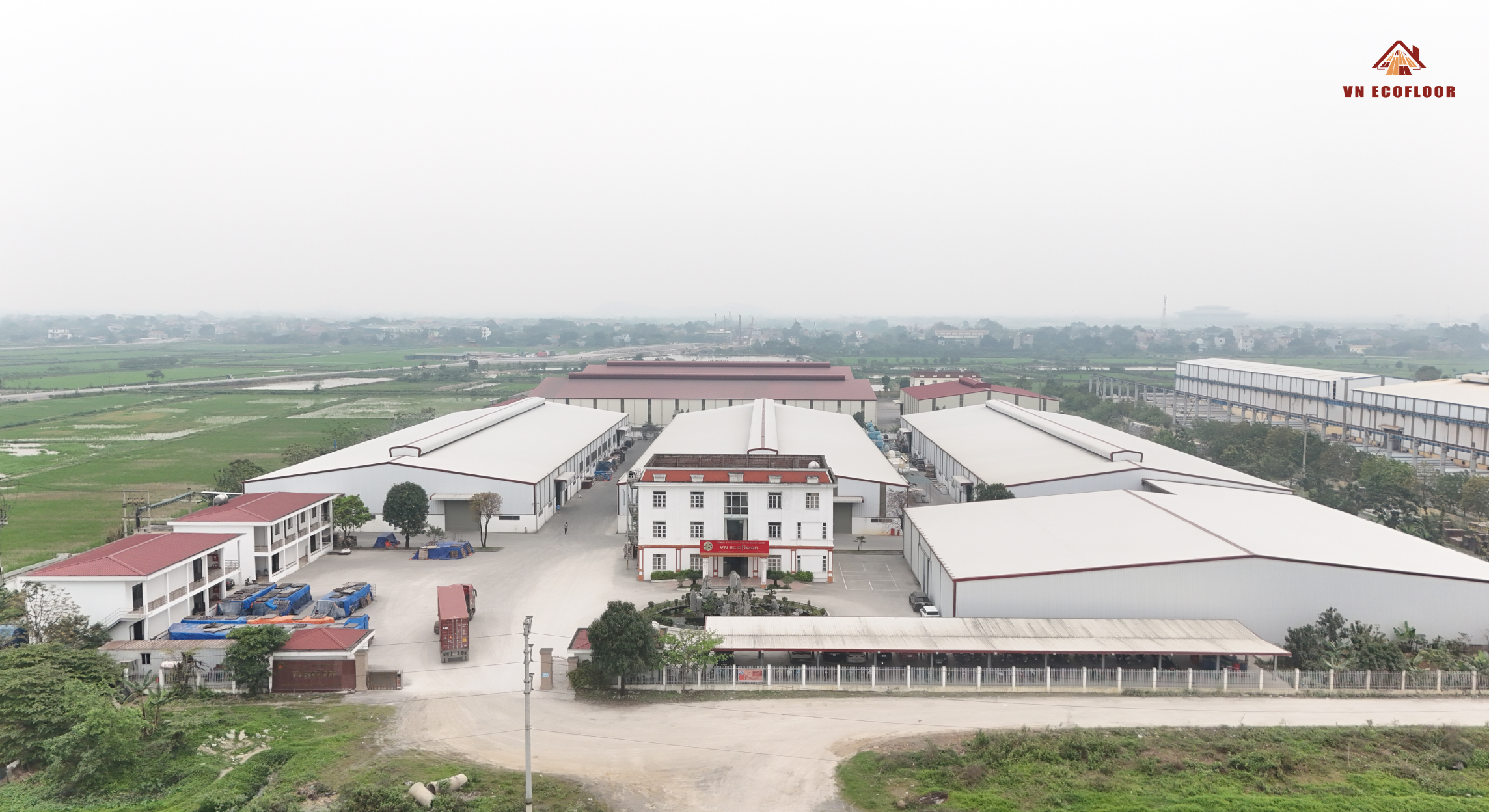
When it comes to the best waterproof flooring for kitchens and bathrooms, the quality of manufacturing is everything. VN Ecofloor is not just a supplier; we are a leading global manufacturer with a decade-long track record of innovation and reliability. Our SPC flooring products have been exported to over 40 countries, appearing in premium residential projects and commercial high-rises across the USA, Europe, and Southeast Asia.
VN Ecofloor maintains a rigorous quality control system, backed by a full suite of international certifications:
- ISO 9001 & ISO 14001: For world-class management and environmental standards.
- CE Marking & FloorScore: Ensuring our products meet strict European safety and indoor air quality (VOC emissions) requirements.
- Advanced Lab Testing: Every batch is tested for peel strength, scratch resistance, and 100% waterproof integrity.
For our B2B partners, we offer more than just a product—we offer a competitive edge:
- Flexible OEM Services: We can customize thickness, wear layers, and unique patterns to match your local market trends.
- High-Capacity Manufacturing: Our state-of-the-art factory ensures consistent supply and on-time delivery for large-scale projects.
- Partner Transparency: We provide full technical documentation and testing reports, ensuring total peace of mind for wholesalers and contractors.
👉 [Explore VN Ecofloor’s Export-Grade Waterproof Collection Today.]
Conclusion
The floors in your kitchen and your bathroom are an investment in the value of your house and the comfort of your family. By making the right decision to use the most waterproof SPC flooring solution, you do away with the threat of water damage in addition to having a beautiful and easy-to-clean surface.
FAQ
- What is the most appropriate bathroom flooring that is waterproof?
The best options are SPC and vinyl flooring. They are available with a 100% waterproof core, better slip resistance, and better underfoot compared to traditional stone or tile.
- Is SPC flooring applicable in the bathrooms?
Yes, SPC flooring is made especially when it is needed in high-moisture locations. The core of its construction is a stone composite; it is completely waterproof and will never develop mold or mildew.
- Would tile be superior to vinyl in wet rooms?
Tile is robust; however, vinyl and SPC are more slip-resistant, easier to install, and much more comfortable on the bare foot.
- What flooring will not suffer from water?
Some of the materials that do not experience structural damage when exposed to water include SPC flooring, porcelain tile, and high-quality sheet vinyl.
- Is a laminate floor waterproof?
No. The majority of the laminate is not waterproofed. It can deal with small spills when cleaned promptly, but it will swell up and be destroyed otherwise when it comes in contact with bathroom steam or when in standing water.